SEO Reporting and Analytics Guide: A Comprehensive Framework for Data-Driven SEO Strategy (2026)
SEO Reporting and Analytics Guide: A Comprehensive Framework for Data-Driven SEO Strategy (2026)
No matter how well-planned your SEO efforts are, they cannot be managed effectively without measurement. Reporting and analytics allow you to monitor the pulse of your SEO strategy, identify what is working, and pinpoint areas that need improvement. According to 2026 data, 62 percent of digital marketing budgets are allocated to channels backed by performance data. SEO reporting is not merely about presenting numbers — it is about telling the story behind those numbers and producing actionable insights that drive real business outcomes.
In this guide, we will cover why SEO reporting is critical, which metrics you should track, how to leverage Google Analytics 4 and Google Search Console data, how to build effective dashboards, automated versus manual reporting, stakeholder communication best practices, ROI calculation methods, and the emerging dimension of AI and GEO reporting metrics.
Why SEO Reporting Matters
SEO reporting is one of the foundational pillars of any digital marketing strategy. Without reporting, you have no way of knowing which tactics are working, which pages are performing, or which areas need improvement.
Stakeholder communication is one of the most critical functions of SEO reporting. Senior management, clients, and team members want to see the tangible impact of SEO efforts. A well-prepared report proves the value of SEO investment and makes future budget approvals significantly easier. Research shows that 78 percent of SEO teams that produce regular reports achieve higher budget approval rates.
ROI justification is the most powerful aspect of reporting. SEO is typically a long-term investment, and its tangible returns may not be visible in the short term. Regular reporting allows you to demonstrate growth in organic traffic, increases in conversion rates, and revenue impact over time, building stakeholder confidence.
Strategy optimization becomes possible only when it is based on data. Which keywords are driving traffic? Which pages have the highest conversion rates? Which technical issues are causing ranking drops? The answers to these questions emerge only through systematic reporting.
Early warning system is another vital role of reporting. It allows you to detect sudden traffic drops, ranking losses, or technical issues before they cause significant damage. With SEOctopus's Dashboard module, you can view all critical metrics on a single screen and spot anomalies immediately.
Key SEO KPIs and Metrics
Effective SEO reporting requires tracking the right metrics. Each metric tells a different story, and when evaluated together, they form a complete picture of your SEO performance.
Organic Traffic
Organic traffic is the number of visitors arriving from search engines without paid advertising. This metric is the most direct indicator of SEO performance. It breaks down into sub-metrics including total organic sessions, new user count, page views, and average session duration. Monthly and year-over-year comparisons are essential for trend analysis.
Keyword Ranking Positions
The positions of your target keywords on search engine results pages (SERPs) are a direct indicator of SEO performance. How many keywords are on the first page (positions 1 through 10)? How many are in the top three? What is the weekly and monthly trend? SEOctopus's Keyword Tracking tool automatically monitors ranking changes for all your target keywords and provides trend graphs you can include directly in your reports.
Click-Through Rate (CTR)
CTR measures the ratio of clicks to impressions in search results. High impressions but low CTR indicates that your title tag or meta description is not compelling enough. Average CTR varies by industry, but generally a rate of 25 to 35 percent is ideal for the first position.
Conversion Rate and Goal Completions
How much of your organic traffic is completing desired actions? Form submissions, product purchases, demo requests, email subscriptions, and document downloads should all be tracked as conversion events. Conversion rate is the clearest indicator of organic traffic quality.
Bounce Rate
The percentage of users who leave after viewing a single page provides important signals about content quality and user experience. A high bounce rate can mean content is not meeting expectations, the page loads too slowly, or the user experience is poor. In GA4, this metric has been inverted as engagement rate, which measures the percentage of engaged sessions.
Domain Authority and Page Authority
Domain Authority (DA) or Domain Rating (DR) measures your site's overall authority level. While this metric is not a direct Google ranking signal, it serves as a useful benchmark for assessing your general competitiveness. Monthly change tracking is recommended.
Technical Health Score
Your site's technical SEO status encompasses crawl errors, broken links, slow pages, mobile usability issues, and structured data errors. SEOctopus's Technical Health Score feature allows you to see your site's technical health as a single score and track changes over time in your reports.
Backlink Metrics
Newly acquired backlinks, lost backlinks, referring domain count, and link quality distribution indicate the health of your backlink profile. Monthly analysis of backlink growth rate and quality is essential for comprehensive reporting.
Google Analytics 4 for SEO
Google Analytics 4 (GA4) continues to be the primary web analytics tool as of 2026. Proper GA4 configuration is critical for SEO reporting.
Creating an Organic Traffic Segment
To isolate organic traffic in GA4, you need to create a segment. Filtering the Traffic Source Medium field to organic is sufficient. With this segment, you can analyze the behavior of organic visitors independently from other channels.
Event and Conversion Tracking
GA4's event-based model captures every user interaction as an event. For SEO reporting, you should mark the following events as conversions: form submission, product purchase, demo request, phone call, email subscription, and document download. By cross-referencing these conversions with your organic traffic segment, you can measure SEO's impact on conversions.
Page-Level Performance Analysis
Which pages receive the most organic traffic? Which pages have the highest conversion rates? Which landing pages have the highest bounce rates? The answers to these questions determine your content optimization priorities. Use GA4's Landing Page report filtered by the organic segment to access this data.
User Journey Analysis
GA4's Path Exploration and Funnel Exploration reports allow you to visualize the journey of organic users through your site. Where do users enter, which pages do they visit, and where do they convert or exit? This information is vital for user experience optimization.
Google Search Console Metrics
Google Search Console (GSC) shows your performance in Google searches using Google's own data. Unlike GA4, GSC also provides pre-click data.
Impressions
The number of times your pages appeared in Google search results indicates your potential reach. High impressions but low clicks signals an opportunity for title and description optimization.
Clicks
The total number of clicks from Google search results to your site is the most accurate measure of your organic traffic volume. It may show slight discrepancies with GA4 data because the measurement methodologies differ.
Average Position
The average ranking of your keywords in Google results summarizes your overall ranking performance. Because this is an aggregate value, it should be broken down by specific keyword groups for meaningful analysis.
CTR (Click-Through Rate)
GSC's CTR data is reported separately for each query and each page. High-impression queries with low CTR are priority targets for title tag and meta description optimization.
Coverage and Indexing Reports
Which pages are indexed, which are returning errors, and which have warnings? These data points are direct indicators of technical SEO health. Fixing indexing issues is one of the fastest ways to increase organic visibility.
Building Effective SEO Dashboards
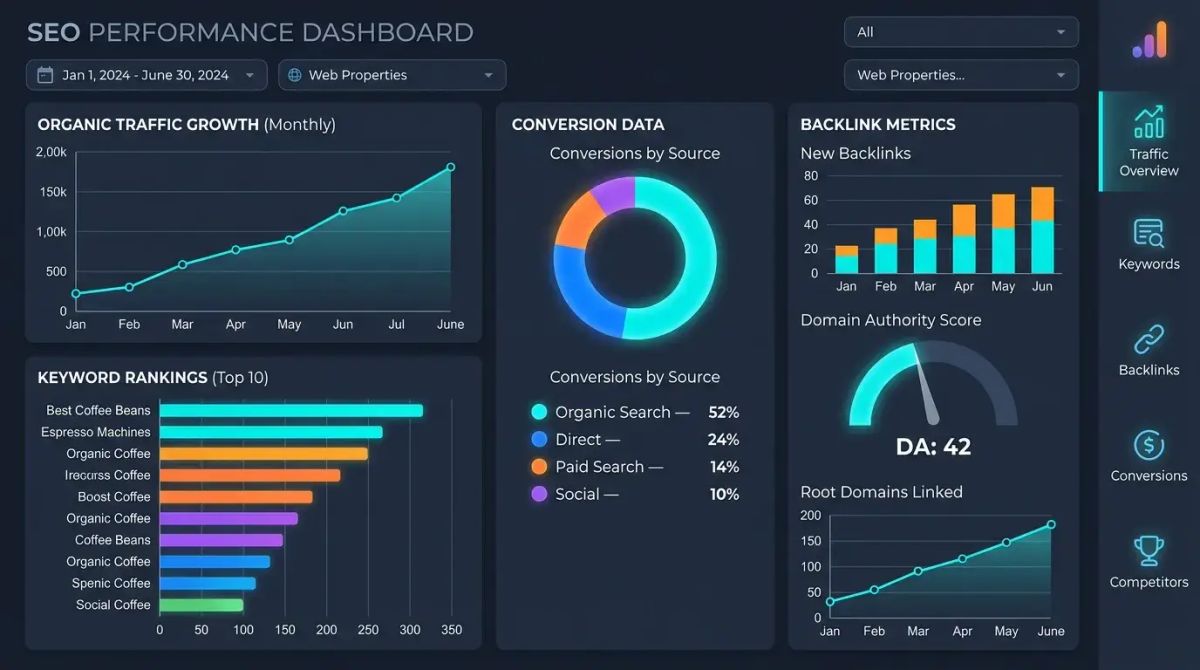
A dashboard that lets you view all your SEO data on a single screen greatly simplifies the reporting process and accelerates insight generation.
Apply a top-down hierarchy. At the top of the dashboard, place KPI summary cards (total organic traffic, conversion count, average position, technical health score). Below that, include trend charts. Further down, add detail tables, and at the bottom, place action recommendations.
Include comparison periods. Compare current month data with the previous month and the same month of the previous year. Year-over-year comparison is critical for understanding seasonal effects.
Segment your data. Break data down by device (desktop, mobile, tablet), by location (country, city), by page group (blog, product pages, landing pages), and by keyword group.
SEOctopus's Dashboard module applies all these principles natively. Organic traffic, ranking changes, technical health score, backlink metrics, and GEO visibility are all displayed on a single screen. Furthermore, the PDF Export feature lets you download this dashboard as a professional report with a single click and share it with your stakeholders.
Automated Versus Manual Reporting
Automating the reporting process saves time, but it should not mean eliminating manual analysis entirely.
Advantages of Automated Reporting
Automated reporting saves time, reduces human error, provides consistent format and timing, and generates periodic reports effortlessly. Weekly summary reports, monthly performance reports, and alert-triggered anomaly reports are all well-suited for automation.
Why Manual Analysis Is Still Necessary
Automated reports collect data but do not interpret it. Understanding the reasons behind the data, making strategic inferences, and developing action recommendations require human analysis. Contextual information such as competitor movements, algorithm updates, and market changes cannot be added to automated reports.
The Ideal Approach
Automate data collection and visualization, and add the analysis and interpretation layer manually. SEOctopus's automatic report generation and PDF Export features fully automate data collection and visualization, allowing you to focus on adding strategic analysis and commentary.
Client and Stakeholder Reporting Best Practices
Different stakeholders require different levels of detail. Tailoring your reports to your audience is critical for effective communication.
Executive Reports
C-level executives want to see business outcomes, not detailed technical metrics. Organic traffic growth as a percentage, conversion and revenue impact, ROI calculation, and competitive comparison are sufficient. These should be presented in a single-page summary format.
Marketing Manager Reports
Marketing managers need to compare channel performance and make budget allocation decisions. Organic traffic versus other channels, campaign-level performance, content performance, and cost efficiency data are required.
Technical Team Reports
Developers and technical SEO teams need detailed technical metrics. Crawl errors, page speeds, Core Web Vitals, indexing status, structured data errors, and mobile usability issues should be presented as actionable technical data.
Client Reports
Reports that agencies present to clients should show both business outcomes and the work performed. A summary of achieved results, a list of completed tasks, the plan for the next period, and return on investment should be clearly presented.
The golden rule of reporting: Every report should contain at least one clear action recommendation. Reports that only present data without recommendations do not produce value.
Monthly, Weekly, and Quarterly Reports
Different reporting periods serve different purposes and audiences.
Weekly Reports
Weekly reports are operationally focused. They include ranking changes, technical errors, new backlinks, and traffic anomalies — data that requires quick action. They are short and summarized; typically a single page or a dashboard screenshot is sufficient.
Monthly Reports
Monthly reports are the most common reporting period. They include month-over-month comparison of all KPIs, a summary of work performed, results achieved, the plan for the next month, and trend analysis. They are typically a detailed document of 5 to 15 pages.
Quarterly Reports
Quarterly reports are strategically focused. They show the big picture, reveal long-term trends, and provide the foundation for strategy revisions. They include progress toward annual goals, ROI analysis, competitive comparison, and strategic recommendations.
At every reporting period, SEOctopus's PDF Export feature allows you to create professional-format reports and share them with stakeholders effortlessly.
SEO Attribution and ROI Calculation
Calculating the return on investment for SEO is more challenging than for other digital marketing channels because SEO impact accumulates over time.
Basic ROI Formula
The basic formula for SEO ROI calculation is: (Revenue from SEO minus SEO cost) divided by SEO cost, multiplied by one hundred. The result gives the ROI value as a percentage.
Organic Traffic Value Calculation
To calculate the value of your organic traffic, use the cost of purchasing the same traffic through Google Ads. This method concretely demonstrates the savings effect of SEO. For example, if you receive 50,000 organic clicks per month and the average CPC is two dollars, the monthly value of your organic traffic is 100,000 dollars.
Conversion-Based ROI
For a more direct ROI calculation, calculate the total revenue value of conversions from the organic channel. Organic conversion count multiplied by average conversion value gives you revenue from SEO. Divide this value by your total SEO expenditure to get ROI.
Attribution Models
GA4's data-driven attribution model measures the role of organic search in the conversion journey more accurately. The last-click model underestimates SEO's impact because organic search is often at the beginning of the conversion journey. Multi-touch attribution models better reflect SEO's true impact.
Common Reporting Mistakes
Avoiding common mistakes in SEO reporting is important for the credibility and effectiveness of your reports.
Focusing on vanity metrics is the most common mistake. Total page views or total backlink count may look impressive but provide little information about business outcomes. Instead, focus on meaningful metrics such as conversion rate, organic revenue, and qualified traffic.
Lack of context is another frequent error. Presenting numbers without context can be misleading. Include external factors such as seasonal effects, algorithm updates, competitor movements, and industry trends in your reports.
Missing action recommendations moves your reports away from producing value. Every report should include at least one concrete recommendation. The question of what the data shows and what should be done based on it should always be answered.
Data overload confuses decision-makers. Prepare reports with different levels of detail for different stakeholder groups. Provide a single-page summary for executives and a detailed report for technical teams.
Inconsistent periods make comparison difficult. Report the same metrics over the same periods consistently. Reporting organic traffic one month and ranking positions the next prevents you from seeing the big picture.
AI and GEO Reporting Metrics
In 2026, SEO reporting has expanded beyond traditional search engines. AI-powered answer engines such as ChatGPT, Google AI Overview, Perplexity, and Gemini have become sources of organic traffic. Measuring and reporting on this new channel is strategically important.
AI Visibility Score
How frequently and prominently your brand or website appears in AI-powered answer engines is measured by the AI visibility score. With SEOctopus's GEO Monitor feature, you can automatically track this score and report changes over time.
Citation Rate
How often AI engines reference your site in their responses is measured as the citation rate. A high citation rate indicates that your content is viewed as a trustworthy source by AI models.
Sentiment Analysis
The ratio of positive, negative, or neutral tone in AI engines' mentions of your brand indirectly measures brand perception. This metric is critical for brand reputation management.
AI Traffic Share
Measuring what percentage of your total organic traffic comes from AI engines helps you understand this channel's growth trajectory. In GA4, you can segment AI-sourced traffic using UTM parameters or referrer analysis.
Prompt-Based Ranking
The position at which your brand appears in AI engine responses for specific user prompts is tracked as prompt-based ranking. This is the AI-world equivalent of traditional keyword ranking.
SEO Reporting Tools
Using the right tools for effective SEO reporting greatly simplifies the data collection and analysis process.
Google Analytics 4 is the fundamental tool for web analytics. It is indispensable for organic traffic analysis, user behavior tracking, conversion tracking, and attribution modeling.
Google Search Console is the primary source for search performance data. It provides impressions, clicks, CTR, position, and indexing data directly from Google.
SEOctopus is a comprehensive SEO tool that unifies all SEO metrics on a single platform. With its Dashboard, you can view all KPIs on one screen. With Keyword Tracking, you can monitor ranking changes. With Technical Health Score, you can measure technical health. With GEO Monitor, you can track your AI visibility. And with PDF Export, you can create professional reports with a single click.
Google Looker Studio (formerly Data Studio) is used for creating customized dashboards and visual reports. It allows you to combine GA4 and GSC data for comprehensive visualizations.
Spreadsheet tools (Google Sheets, Excel) are still widely used for detailed data analysis, pivot tables, and custom calculations.
Frequently Asked Questions
How often should SEO reporting be done?
The ideal reporting frequency depends on your project size and stakeholder expectations. As a general rule, create weekly operational summaries, monthly detailed performance reports, and quarterly strategic assessments. For large sites or active SEO campaigns, daily alert reports can also be valuable. SEOctopus's Dashboard module lets you monitor metrics in real time.
Which KPIs must be included in an SEO report?
Essential SEO KPIs include organic traffic (session count and user count), keyword ranking positions, click-through rate (CTR), conversion rate and conversion count, bounce rate or engagement rate, technical health score, and backlink metrics. In addition, AI visibility score and citation rate are increasingly being added to reports in 2026. Each KPI should include a comparison with the previous period and trend information.
Are data discrepancies between Google Analytics 4 and Google Search Console normal?
Yes, data discrepancies between GA4 and GSC are expected. GA4 measures traffic arriving at your site using JavaScript-based tracking, while GSC provides Google's own search data. Ad blockers, JavaScript loading issues, and measurement methodology differences cause these inconsistencies. Using both tools together gives you a more complete picture.
How do you calculate SEO ROI?
There are two primary approaches to calculating SEO ROI. First, calculate the PPC equivalent of your organic traffic: organic click count multiplied by average CPC value gives you the monetary value of your traffic. Second, calculate the total revenue value of conversions from the organic channel and divide it by your SEO cost. In both approaches, SEO cost should include personnel, tool subscriptions, content production, and external service procurement.
Is automated SEO reporting sufficient, or is manual analysis also needed?
Automated reporting is ideal for data collection and visualization, but it is not sufficient on its own. Interpreting data, adding context, making strategic inferences, and developing action recommendations require manual analysis. The ideal approach is to automate data collection and support the analysis layer with human expertise. SEOctopus's PDF Export feature handles automatic data collection and visualization while you focus on adding strategic commentary.
How should AI and GEO metrics be included in SEO reports?
AI and GEO metrics have become an integral part of SEO reports in 2026. Add AI visibility score, citation rate, AI-sourced traffic share, and prompt-based ranking metrics to your reports. Present these metrics alongside traditional SEO metrics to comprehensively report on both search engine and AI engine performance. SEOctopus's GEO Monitor tool automatically tracks these metrics and simplifies your reporting process.
How should different reports be prepared for different stakeholder groups?
Each stakeholder group needs a different level of detail. For executive leadership, prepare a single-page summary report focused on business outcomes (traffic growth, revenue impact, ROI). For marketing managers, prepare a medium-detail report including channel comparison and campaign performance. For technical teams, present a detailed technical report including crawl errors, page speeds, indexing issues, and a technical action list. Having a common summary section across all stakeholder reports improves consistency.
Conclusion
SEO reporting and analytics is an indispensable component of a successful SEO strategy. Tracking the right metrics, presenting data meaningfully, and producing actionable insights proves the value of your SEO investments and supports future strategic decisions. In 2026, AI and GEO metrics have been added alongside traditional search engine metrics. Comprehensively reporting your performance in both search engines and AI engines is essential for a holistic digital visibility strategy. With SEOctopus's Dashboard, Keyword Tracking, Technical Health Score, GEO Monitor, and PDF Export tools, you can manage your SEO reporting completely, data-driven, and professionally.