Best SEO Tools Comparison Guide: Ahrefs, SEMrush, Moz and More (2026)
Best SEO Tools Comparison Guide: Ahrefs, SEMrush, Moz and More (2026)
The SEO landscape in 2026 is more competitive and complex than ever before. Search engine algorithms evolve continuously, AI-powered search results have become mainstream, and Generative Engine Optimization (GEO) has emerged as a critical new discipline. In this environment, choosing the right SEO tools is not merely a convenience but a strategic necessity that directly impacts your organic search performance.
However, with hundreds of SEO tools available on the market, each offering different features, pricing models, and specializations, selecting the right ones can feel overwhelming. Should you invest in a single all-in-one platform or combine multiple specialized tools? Are free tools sufficient or do you need premium solutions? Which tools actually deliver measurable ROI?
This comprehensive guide compares the most popular and effective SEO tools of 2026, organized by category, with honest assessments of their strengths, weaknesses, pricing, and ideal use cases. We will also explore tool stacking strategies and emerging AI-powered solutions to help you build the perfect SEO toolkit.
Why You Need SEO Tools in 2026
SEO is no longer a simple discipline of keyword research and link building. Modern SEO is a multi-layered practice that demands sophisticated tooling to execute effectively.
Data volume has exploded. Google processes billions of searches daily and search behavior constantly shifts. Tracking which keywords drive traffic, understanding competitor strategies, and monitoring your site's technical health requires automated tools that can process massive datasets in real time.
AI-powered search results add a new dimension. Google's AI Overviews, Bing's Copilot integration, and ChatGPT's search capabilities have created entirely new visibility metrics beyond traditional rankings. You now need to monitor not just your position in search results but how your brand is represented in AI-generated responses.
Technical complexity has increased. Core Web Vitals, structured data, JavaScript rendering, crawl budget optimization, and international SEO are technical domains that require specialized tools to manage effectively. Manual auditing of these areas is impractical for any site of meaningful size.
Competition has intensified. Organic search competition grows across virtually every industry. Understanding your competitors' strategies, identifying content gaps, and discovering link building opportunities requires comprehensive analysis capabilities that only professional tools can provide.
Categories of SEO Tools
SEO tools can be classified into seven primary categories. Each category addresses different needs and some tools span multiple categories.
All-in-One Platforms
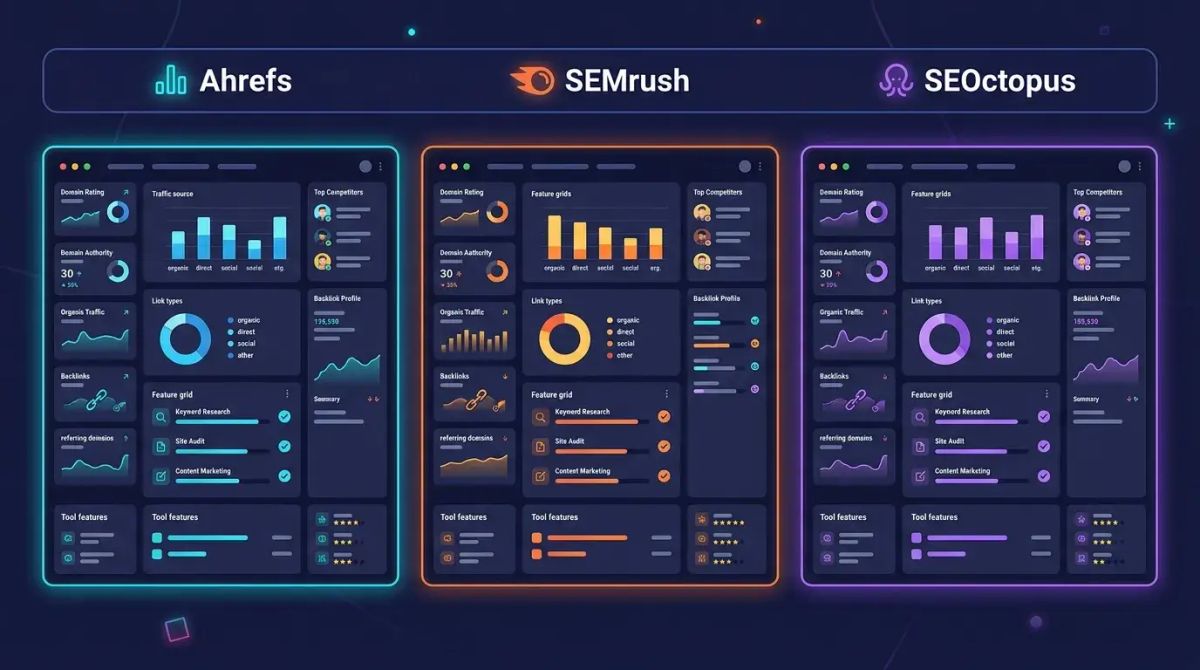
These tools combine keyword research, backlink analysis, rank tracking, site auditing, and competitor analysis under one roof. Ahrefs, SEMrush, and SEOctopus are leading examples in this category.
Keyword Research Tools
Specialized tools that provide search volume, competition metrics, keyword difficulty scores, and related keyword suggestions. Google Keyword Planner, Ubersuggest, and KeywordTool.io fall into this category.
Backlink Analysis Tools
Tools that allow you to examine your backlink profile, discover new link opportunities, and analyze competitor link strategies. Ahrefs and Majestic are leaders in this space.
Technical SEO Tools
Tools that audit your website's technical health, identify crawl errors, and flag performance issues. Screaming Frog and Sitebulb are the category leaders.
Content Optimization Tools
Tools designed to improve content quality, identify content gaps, and build data-driven content strategies. Surfer SEO and Clearscope lead this category.
Rank Tracking Tools
Tools that monitor your keyword positions in search results on a daily basis and provide historical trend data. SE Ranking and AccuRanker are prominent examples.
GEO and AI Monitoring Tools
This is the newest category. These tools track how your brand appears in AI-generated search responses and help you optimize for generative engines. SEOctopus is one of the few platforms offering specialized solutions in this emerging field.
Ahrefs: The Backlink Authority
Ahrefs has built one of the world's largest backlink databases and has become the industry standard for link analysis and competitive research.
Pros
Ahrefs' greatest strength is undeniably its backlink database. Crawling trillions of web pages and indexing billions of backlinks, Ahrefs provides the most comprehensive data source for link profile analysis. Site Explorer lets you examine any domain or URL's backlink profile, organic keywords, and estimated traffic.
Keyword Explorer offers powerful keyword research capabilities with search volume, keyword difficulty, click-through rate estimates, and detailed SERP analysis. Content Explorer helps you find the most shared and linked content on any topic, making it invaluable for content strategy and link building prospecting.
Site Audit provides comprehensive technical SEO auditing with issues prioritized by impact. Rank Tracker monitors daily ranking changes across multiple search engines and locations.
Cons
Ahrefs' most significant drawback is its price point. Even the entry-level plan can be costly for small businesses and freelancers. The platform also has limited capabilities for AI-powered search monitoring and GEO tracking. Content optimization tools are not as deep as those offered by dedicated platforms like Surfer SEO.
The user interface can feel complex initially and the learning curve is relatively steep for beginners. Local SEO features are also more limited compared to some competitors.
Pricing
As of 2026, Ahrefs plans start at 99 dollars per month for the Lite plan with a single user. The Standard plan costs 199 dollars per month, the Advanced plan runs 399 dollars per month, and Enterprise pricing starts at 999 dollars per month.
Best For
Ahrefs is ideal for mid-size to large businesses focused on backlink analysis, competitor research, and content marketing strategy. It is an essential tool for anyone running link building campaigns.
SEMrush: The Digital Marketing Suite
SEMrush goes beyond SEO to include PPC management, social media tools, and content marketing capabilities, making it a comprehensive digital marketing platform.
Pros
SEMrush's greatest advantage is its breadth of tools. Combining SEO, PPC, content marketing, social media management, and competitive intelligence in a single platform makes it an incredibly versatile solution for marketing teams.
Keyword Magic Tool is one of the most comprehensive keyword research tools in the industry, offering billions of keyword suggestions with advanced filtering options. Position Tracking provides daily rank monitoring with local search capabilities.
Site Audit delivers detailed technical SEO analysis with issues prioritized by severity. Backlink Analytics and Link Building Tool enable thorough link profile analysis and opportunity discovery.
SEMrush's content marketing tools are notably strong. SEO Content Template, SEO Writing Assistant, and Topic Research help build comprehensive content strategies from ideation through optimization.
Cons
SEMrush's most notable drawback is its complex interface. The sheer number of tools and features can be overwhelming for new users. Its backlink database is not as extensive as Ahrefs'. Pricing is on the higher end and some advanced features require additional costs beyond the base plan.
AI-powered search monitoring and GEO optimization capabilities are still limited. Reporting features can be complex to customize and occasionally challenging to configure for client-facing deliverables.
Pricing
As of 2026, the Pro plan starts at 129.95 dollars per month, the Guru plan at 249.95 dollars per month, and the Business plan at 499.95 dollars per month. Additional users and advanced features incur extra charges.
Best For
SEMrush is ideal for digital marketing agencies and large teams that manage multiple marketing channels from a single platform. If you manage both PPC and SEO campaigns, SEMrush is a natural choice.
Moz: The Education-First Platform
Moz is one of the oldest and most respected brands in the SEO industry. Founded by Rand Fishkin, the company is known for its contributions to SEO education and community building.
Pros
Moz's Domain Authority metric is one of the most widely adopted authority measurements in the industry. As a simple and intuitive metric, it is broadly accepted for evaluating link profile quality at a glance.
The user interface is significantly simpler and more user-friendly than its competitors. Even SEO beginners can navigate the platform with ease. MozBar, the browser extension, provides quick metric access while analyzing SERP results.
Keyword Explorer offers keyword difficulty and opportunity scores that simplify keyword prioritization. Site Crawl identifies technical issues and provides fix recommendations with clear explanations.
Moz's most significant advantage is its educational resources. The Moz Blog, Whiteboard Friday video series, and SEO Learning Center are among the most valuable free resources in the industry.
Cons
Moz's backlink database is significantly smaller than those of Ahrefs and SEMrush. Data refresh rates also lag behind competitors. Advanced features and tool variety are limited compared to the broader platforms.
International SEO support and multi-language capabilities are limited. AI and GEO monitoring features are absent. Site audit capacity may be insufficient for large-scale websites.
Pricing
As of 2026, Moz Pro plans start at 99 dollars per month for Standard, 179 dollars per month for Medium, 299 dollars per month for Large, and 599 dollars per month for Premium.
Best For
Moz is ideal for small businesses new to SEO and freelance SEO professionals. Its intuitive interface and rich educational resources accelerate the learning process.
Screaming Frog: The Technical SEO Workhorse
Screaming Frog SEO Spider is a desktop-based website crawler that has become the industry standard for technical SEO auditing.
Pros
Screaming Frog's greatest strength is its depth of technical analysis. It crawls your entire website and identifies broken links, redirect chains, missing meta tags, duplicate content, page size issues, structured data errors, and dozens of other technical problems.
Data is processed locally on your machine, which enables fast crawling even for large websites. Advanced configuration options let you customize crawl behavior to match your specific needs. Integrations with Google Analytics, Search Console, and PageSpeed Insights add additional data layers for comprehensive analysis.
The free version allows crawling up to 500 URLs, which is sufficient for small websites.
Cons
Screaming Frog is a desktop application and is not cloud-based. Sharing crawl results with team members and scheduling automated crawls is less convenient than cloud platforms. The interface is oriented toward technical users and can be intimidating for beginners.
It does not include keyword research, backlink analysis, or rank tracking capabilities. It is purely a technical site auditing tool.
Pricing
The free version is limited to 500 URLs. The paid license costs 259 dollars per year and includes unlimited URL crawling, scheduled crawls, and advanced features.
Best For
Screaming Frog is essential for technical SEO specialists, web developers, and agencies conducting in-depth technical audits of large websites.
Google Search Console: Free and Essential
Google Search Console is Google's free tool that every website owner should use without exception.
Key Features
Google Search Console provides direct access to Google's own data about your organic search performance. You can see which queries you appear for, your click-through rates, average positions, and impression counts with authoritative first-party data.
Index coverage reports show how Google indexes your pages. Crawl errors, indexing issues, and coverage reports help identify technical problems. The URL Inspection tool provides detailed indexing status for individual pages.
Core Web Vitals reports track your page experience metrics. Mobile usability reports identify mobile-friendliness issues. Structured data reports flag schema markup errors and validation problems.
Limitations
Google Search Console only provides sixteen months of historical data. It does not include competitor analysis or backlink profile features. Reporting and data export options are limited. Data updates have inherent delays with some metrics reported several days after the fact.
Best For
Google Search Console is mandatory for every website. When used alongside paid tools, it provides authoritative Google-sourced data that improves analysis accuracy. Platforms like SEOctopus integrate Search Console data into their analytics dashboards to provide a more comprehensive performance view.
Surfer SEO: The Content Optimization Specialist
Surfer SEO is a platform focused specifically on content optimization, helping you build data-driven content strategies based on SERP analysis.
Pros
Surfer SEO's Content Editor helps you write content optimized for specific keywords. It analyzes top-ranking content for structure, length, and keyword usage patterns, then provides real-time recommendations as you write.
SERP Analyzer offers detailed analysis of search result pages and visualizes ranking factors. The Audit tool analyzes your existing content and provides specific improvement recommendations. Keyword Research is tailored for content-focused keyword discovery.
AI-powered content generation features accelerate the content creation process. The Topical Map feature helps you build comprehensive content strategies for entire topic clusters.
Cons
Surfer SEO focuses exclusively on content optimization. It does not include backlink analysis, technical SEO auditing, or rank tracking. It is not a standalone SEO solution and needs to be used alongside other tools.
Pricing scales with content volume and can become expensive for high-volume content producers. AI recommendations are not always accurate and require human review and editorial judgment.
Pricing
As of 2026, the Essential plan starts at 89 dollars per month, the Scale plan at 129 dollars per month, and the Scale AI plan at 219 dollars per month.
Best For
Surfer SEO is ideal for content marketing teams, content writers, and agencies building SEO-driven content strategies.
SE Ranking: The Affordable Alternative
SE Ranking provides the core features of major platforms at a more accessible price point, making professional SEO tools available to smaller budgets.
Pros
SE Ranking's greatest advantage is its price-to-performance ratio. It offers keyword research, rank tracking, site auditing, backlink analysis, and competitor research at competitive prices that undercut the major platforms significantly.
Rank tracking provides daily updates with support for most geographic locations. The site audit tool delivers comprehensive technical analysis. The backlink checker helps monitor your link profile. The marketing plan feature helps organize your SEO workflow and tasks.
White label reporting enables agencies to deliver branded reports to clients. API access allows integration with other tools and custom workflows.
Cons
SE Ranking's database size is smaller than those of Ahrefs and SEMrush. Advanced features and data depth are limited. AI-powered features and GEO monitoring capabilities are not available.
Content optimization tools are not as sophisticated as Surfer SEO. The platform may fall short for large-scale enterprise requirements.
Pricing
As of 2026, the Essential plan starts at 55 dollars per month. The Pro plan starts at 109 dollars per month and the Business plan at 239 dollars per month.
Best For
SE Ranking is ideal for small to mid-size businesses, freelance SEO professionals, and agencies with limited budgets. It covers essential SEO needs at an affordable price.
SEOctopus: The Next-Generation AI and GEO-Powered Platform
SEOctopus combines the core features of traditional SEO tools with AI-powered analysis and Generative Engine Optimization monitoring capabilities, positioning it as a forward-looking platform built for the new era of search.
Pros
SEOctopus's most distinctive differentiator is its GEO monitoring capability. While other tools track only traditional search results, SEOctopus monitors how your brand is represented in AI-powered search responses. You can track your brand's visibility across Google AI Overviews, Bing Copilot, and ChatGPT search features.
It provides keyword research, rank tracking, site auditing, and competitor analysis as core SEO functions within a single platform. AI-powered content recommendations and optimization tools strengthen your content strategy with actionable insights.
Multi-language and multi-region support makes it ideal for international SEO strategies. Full support is available in Turkish, English, German, and many other languages. The user interface is modern and intuitive with a dashboard that gives you a complete overview of all your SEO metrics at a glance.
The traffic analysis module lets you monitor organic search performance in detail. Competitor comparison features help you understand rival strategies. Automated reporting generates regular performance reports for stakeholders.
Cons
As a relatively newer platform, SEOctopus's backlink database is not yet as large as those of platforms like Ahrefs that have been collecting data for many years. Community and educational resources are not yet as extensive as those of Moz or SEMrush. Third-party integrations are continuously expanding but not all integrations are available yet.
Pricing
SEOctopus offers competitive pricing that makes it particularly accessible for small and mid-size businesses. A free trial period lets you test the platform without risk before committing.
Best For
SEOctopus is ideal for businesses that want to monitor and optimize their visibility in AI-powered search results, international brands running multi-language SEO strategies, and teams that want to manage traditional SEO and GEO from a single platform.
Free vs Paid Tools: When Is Free Enough?
When it comes to SEO tools, free solutions can be sufficient for certain situations. However, serious SEO strategies inevitably require investment in paid tools.
When Free Tools Are Sufficient
If you are just starting with SEO and learning the fundamentals, free tools provide a solid starting point. Google Search Console, Google Analytics, and the free version of Screaming Frog cover your basic analysis needs.
If you manage a small personal blog or portfolio site, free tools will be adequate in most cases. Tracking a limited number of keywords and identifying basic technical issues is usually sufficient for these use cases.
When to Upgrade to Paid Tools
When organic search traffic becomes critical to your business objectives, it is time to invest in paid tools. Competitor analysis, comprehensive backlink profiling, and auditing large websites at scale require capabilities that free tools cannot provide.
If you manage client portfolios as an agency, professional tools are a requirement. White label reporting, multi-project management, and advanced analytics are available only in paid plans.
If you need to monitor your visibility in AI-powered search results, this area is almost entirely dominated by paid solutions. Platforms like SEOctopus offer features that cover this emerging space.
How to Choose the Right SEO Tool
Choosing the right SEO tool requires clearly defining your needs first. The following criteria will guide your decision process.
Budget is the most fundamental determining factor. How much can you spend monthly? For smaller budgets, competitively priced platforms like SE Ranking or SEOctopus may be more suitable. For larger budgets, the advanced plans of Ahrefs or SEMrush provide more comprehensive solutions.
Team size is an important consideration. If you work solo, single-user plans are sufficient. Larger teams need multi-user support, role-based access, and collaboration features.
Priority needs should direct your tool selection. If backlink analysis is your priority, Ahrefs excels. If content optimization is your focus, Surfer SEO leads. If technical auditing is paramount, Screaming Frog is the standard. If AI and GEO monitoring is your priority, SEOctopus offers unique solutions in this space.
Site size determines technical requirements. Most tools are adequate for small sites. However, sites with hundreds of thousands of pages require enterprise-level crawling capacity and API access.
Language and region requirements matter if you conduct international SEO. Platforms with multi-language and multi-region support should be prioritized. SEOctopus provides strong support in this area.
Tool Stacking Strategy: Which Tools Complement Each Other
Most professional SEO practitioners do not rely on a single tool but combine multiple tools for maximum effectiveness. The right combination depends on your specific needs and budget.
Starter Stack
For small businesses new to SEO, the optimal combination is Google Search Console, the free version of Screaming Frog, and SEOctopus's entry-level plan. This stack covers basic traffic monitoring, technical auditing, and rank tracking with GEO visibility.
Growth Stack
For growing businesses and freelance SEO professionals, SEOctopus's mid-tier plan combined with Surfer SEO and a paid Screaming Frog license is an effective combination. SEOctopus handles all-in-one SEO and GEO monitoring, Surfer SEO strengthens content optimization, and Screaming Frog provides deep technical analysis.
Professional Stack
For agencies and large businesses, the combination of Ahrefs or SEMrush advanced plans for comprehensive data, SEOctopus for GEO monitoring, Screaming Frog for technical auditing, and Surfer SEO for content optimization covers all SEO domains comprehensively.
Enterprise Stack
For large-scale enterprise projects, you may need SEMrush Business or Ahrefs Enterprise for data depth, SEOctopus enterprise for GEO and AI monitoring, Screaming Frog for technical crawling, and custom API integrations connecting all tools. At this level, tool integration and automated data flow between platforms become critically important.
Emerging AI-Powered SEO Tools
In 2026, AI-powered SEO tools are rising rapidly. These tools enhance traditional SEO functions with artificial intelligence to deliver faster and more effective results.
AI content generation and optimization has become a standard feature across most platforms. However, quality control of AI-generated content and alignment with brand voice still requires human oversight and editorial judgment.
Automated SEO audits have become faster and more comprehensive thanks to AI. Beyond identifying technical issues, AI can now provide detailed remediation recommendations with priority scoring.
Predictive analytics powered by AI analyze historical data patterns to forecast future traffic trends and ranking changes, enabling proactive strategy adjustments.
GEO monitoring and optimization is the most exciting development area. The proliferation of AI-powered search engines has created new metrics and monitoring methodologies beyond traditional rank tracking. SEOctopus is among the platforms leading this space with comprehensive solutions for monitoring brand visibility in AI-generated search responses.
Natural language processing for keyword analysis uses AI to better understand search intent, making keyword research more semantic and context-aware than ever before.
Frequently Asked Questions
What is the best SEO tool overall?
There is no single best SEO tool for every situation. The most suitable tool depends on your specific needs, budget, and team size. Ahrefs excels at backlink analysis, SEMrush leads in comprehensive digital marketing, Surfer SEO specializes in content optimization, and SEOctopus stands out for AI-powered GEO monitoring. Most professionals use a combination of two to four tools for complete coverage.
Are free SEO tools sufficient for serious work?
Free tools can be adequate for SEO beginners and small websites. Google Search Console and the free version of Screaming Frog cover basic needs. However, serious SEO strategies that require comprehensive keyword research, competitor analysis, and advanced reporting demand investment in paid tools. The ROI of paid tools typically justifies the investment through improved organic traffic and revenue.
Should I choose Ahrefs or SEMrush?
Ahrefs excels particularly in backlink analysis and content discovery. SEMrush offers a broader range of tools across digital marketing including PPC management. If you focus purely on SEO, Ahrefs may be the stronger choice. If you manage multiple digital marketing channels, SEMrush is the more logical option. Many professionals use both for their complementary strengths.
What is GEO monitoring and why does it matter?
GEO stands for Generative Engine Optimization. GEO monitoring tracks how your brand is represented in AI-powered search responses. As Google AI Overviews and ChatGPT begin replacing traditional search results for many queries, monitoring your visibility in these AI-generated responses has become critically important. SEOctopus offers specialized monitoring tools specifically designed for this purpose.
How many SEO tools should I use?
The ideal combination is typically between two and four tools. An all-in-one platform covers your core needs while specialized tools provide depth in specific areas. For example, you might use SEOctopus for general SEO and GEO monitoring, Surfer SEO for content optimization, and Screaming Frog for technical auditing. Using too many tools can lead to data confusion and workflow inefficiency.
How much should I budget for SEO tools?
Budget depends on your business size and the importance of SEO to your business objectives. Small businesses might budget between 50 and 150 dollars per month. Mid-size businesses typically spend between 200 and 500 dollars per month. Large businesses and agencies may allocate over 500 dollars per month. The key is measuring the value your tools deliver and thinking in terms of ROI rather than absolute cost.
What is the biggest trend in SEO tools for 2026?
The biggest trend of 2026 is AI integration and GEO monitoring. The rise of AI-powered search engines has created entirely new monitoring requirements beyond traditional rank tracking. Additionally, AI-powered content optimization, automated technical auditing, and predictive analytics are becoming standard features. Platforms like SEOctopus that have adopted these trends early are providing significant competitive advantages to their users.
Which SEO tool is best for agencies?
The best tool for agencies depends on client needs and agency size. Large agencies typically use SEMrush or Ahrefs agency plans with white label reporting capabilities. Small to mid-size agencies may prefer more affordably priced platforms like SEOctopus or SE Ranking. The critical requirements are client reporting capabilities, multi-project management, and team collaboration features.