AI Content Detection and SEO Guide: How Does Google Rank AI-Generated Content? (2026)
AI Content Detection and SEO Guide: How Does Google Rank AI-Generated Content? (2026)
The content creation landscape has undergone a fundamental transformation in 2026. Large language models such as ChatGPT, Claude, Gemini, and others have made text generation accessible to virtually anyone. Yet this revolution brings critical questions to the forefront. Does Google penalize AI-generated content? How reliable are AI content detection tools? How should you position artificial intelligence within your SEO strategy?
In this comprehensive guide, we will examine how AI content detection works, what Google truly thinks about AI-generated content, the real accuracy rates of detection tools, and the best practices for achieving SEO success with AI-assisted content creation.
The Rise of AI-Generated Content
Over the past three years, AI content generation has experienced extraordinary momentum. The wave that began with the widespread adoption of ChatGPT in 2023 grew through the advanced capabilities of Claude and Gemini in 2024, and by 2026 it has become an inseparable part of professional content production.
Content creation workflows have changed fundamentally. Blog posts, product descriptions, social media updates, email marketing copy, and even technical documentation are being produced with AI assistance on a regular basis. Research indicates that in 2026, more than 65 percent of enterprise content production involves artificial intelligence in some capacity.
This growth has naturally brought concerns and questions along with it. Will content quality decline? Will search engines detect and penalize AI content? Can AI-generated content compete with content written entirely by humans? To answer these questions, we first need to understand Google's official stance.
Google's Stance on AI-Generated Content
Google's approach to AI-generated content delivers a very clear and consistent message: Google is not anti-AI, it is anti-low-quality.
Google's Search Quality team has stated on multiple occasions that the method of content creation does not matter; what matters is the quality of the content and the value it delivers to users. Google's Helpful Content system focuses not on whether content was written by AI or a human, but on whether the content serves the user's intent.
Google's official position is as follows:
- Being AI-generated is not by itself a reason for penalization
- The Helpful Content Update evaluates content quality, not production method
- E-E-A-T signals are assessed independently of how content was created
- Spam policies target low-quality mass-produced content, not AI content specifically
- Automatically generated spam content remains within the scope of penalties
This distinction is critically important. Google draws a clear line between quality content that uses AI and spam content that abuses AI. An article written with AI assistance can rank well if it contains original information, provides a comprehensive answer to the user's query, and is based on reliable sources.
SEOctopus's Content Analysis module lets you evaluate your content against Google's Helpful Content criteria and see your quality scores in real time.
How AI Content Detection Works
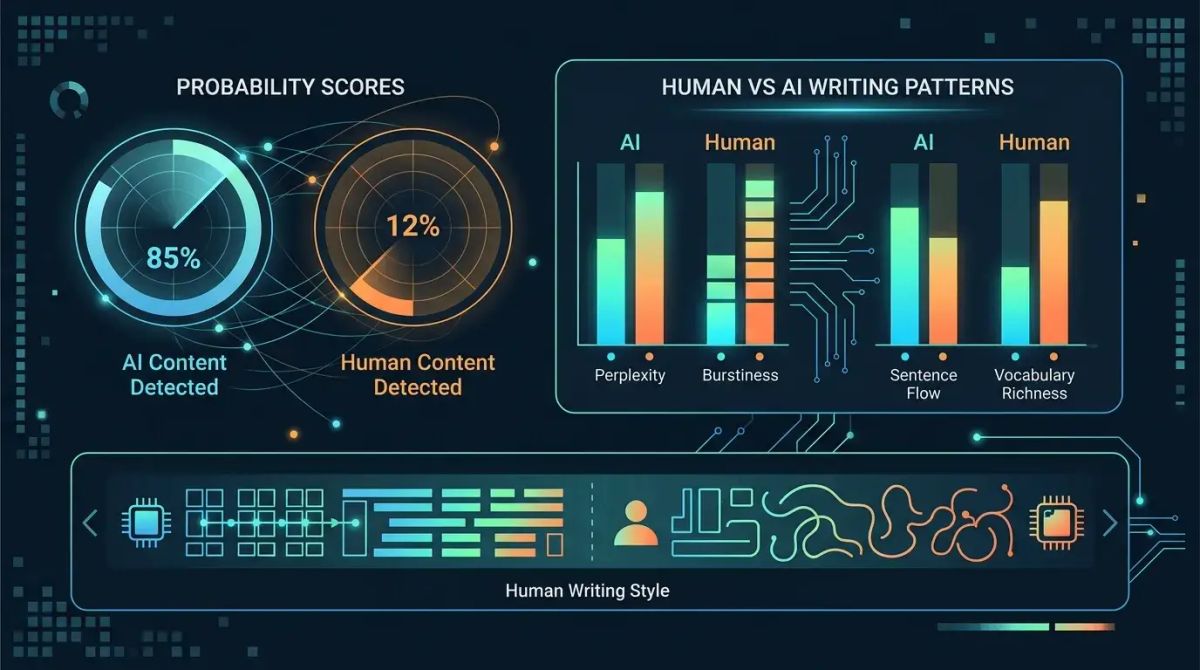
AI content detection tools use various statistical and linguistic methods to determine whether text was generated by artificial intelligence. Understanding how these methods work is essential both for grasping the limitations of detection tools and for creating better content.
Perplexity Analysis
Perplexity measures how predictable a language model finds a given text. AI-generated text tends to have lower perplexity values because AI models have a statistical tendency to select the most probable words. Human writers, on the other hand, use unexpected word choices, idioms, and personal expression styles that produce higher perplexity values.
Burstiness Analysis
Burstiness measures the variance in sentence lengths and complexity levels within a text. Human writers naturally alternate between short and long sentences, sometimes using simple structures and sometimes complex ones. AI tends to produce a more consistent and homogeneous sentence structure. Texts with low burstiness scores are flagged as AI-generated.
Watermarking Technology
Some AI providers embed invisible digital watermarks in the text they generate. These watermarks are embedded in statistical patterns within specific word choices and can be detected with specialized tools. However, this method is only applicable to models that implement watermarking and loses its effectiveness when text is rewritten or heavily edited.
Stylometric Analysis
Stylometric analysis is an approach that statistically measures the unique writing style of an author. It examines features such as word distribution, sentence structure preferences, conjunction usage, and paragraph organization to determine whether a text was produced by a human writer or an AI model.
Popular AI Content Detection Tools and Their Real Accuracy Rates
There are numerous AI content detection tools on the market. However, the real accuracy rates of these tools fall significantly short of their marketing claims. Independent tests and academic research have revealed that detection tools have serious limitations.
GPTZero is one of the most widely used detection tools. It uses perplexity and burstiness metrics. In independent tests, it shows accuracy rates between 70 and 85 percent, but accuracy drops considerably on rewritten or edited texts.
Originality.ai takes a more aggressive detection approach with high sensitivity. However, this sensitivity brings a high false positive rate. It can sometimes flag text written entirely by humans as AI-generated.
Copyleaks offers multilingual support and combines plagiarism detection with AI detection. Its accuracy rate for non-English content is noticeably lower than for English content.
ZeroGPT is a free and easily accessible tool, but its accuracy rate is lower compared to other tools and it can produce inconsistent results.
An important reality is that all of these tools make mistakes. In an independent academic study, 15 to 25 percent of texts written by professional human writers were incorrectly flagged as AI-generated. The same study found that 30 to 50 percent of AI-generated but professionally edited texts were incorrectly classified as human-written.
For this reason, the results of AI content detection tools should not be trusted with absolute certainty. These tools can provide an indication, but they cannot be used as a definitive decision mechanism.
Does Google Penalize AI Content?
This question is at the top of the list for SEO professionals. The answer is clear: Google does not penalize AI content; it penalizes low-quality content that adds no value to users.
Google's SpamBrain system and Helpful Content Update algorithm focus not on how content was produced but on these criteria:
- Does the content match the user's search intent?
- Does the content offer original information or a unique perspective?
- Is the content comprehensive and in-depth?
- Is the content based on reliable sources?
- Does the content carry E-E-A-T signals?
- Was the content created for real users or just for search engines?
If your AI-generated content meets these criteria, it will not have a negative impact on your Google rankings. However, if you are using AI to mass-produce low-quality, repetitive content that adds no value to users, you are at high risk of triggering Google's spam filters.
When AI Content Helps SEO
AI content creation, when used correctly, can significantly boost SEO performance. Here are the areas where AI content delivers the most benefit:
Scalable Content Production
For large e-commerce sites, geographically targeted pages, or data-driven content, AI provides a tremendous scaling tool. For example, thousands of product descriptions, hundreds of city-specific landing pages, or regularly updated data reports can be produced dramatically faster with AI assistance.
SEOctopus's AI Writer module allows you to automate geographic and language-based content scaling, producing localized and SEO-optimized content for every target market.
Data-Driven Content
AI is extremely effective in data-driven content such as statistical reports, market analyses, and benchmark content. Transforming large datasets into meaningful narratives, writing chart and table interpretations, and creating content based on current data are all areas where AI excels.
Multilingual Content Strategy
AI provides a major advantage for brands looking to establish a presence across multiple languages and markets. Creating adapted content in multiple languages from a single source piece is both faster and more cost-effective than traditional translation.
Content Drafting and Structuring
AI is excellent for one of the most time-consuming stages of content production: creating the initial draft and structure. Building a content skeleton based on keyword research results, converting competitive analysis data into a content plan, and designing heading hierarchies can all be done much more efficiently with AI.
When AI Content Hurts SEO
Incorrect or careless use of AI can seriously damage SEO performance. Pay particular attention to these situations:
Thin and Generic Content
The default output of AI is typically generic, superficial, and undifferentiated text. If you publish AI output directly without any editing or enrichment, your content will be lost among hundreds of similar pages. Google's Helpful Content system specifically targets this type of thin content.
Lack of E-E-A-T
Experience, Expertise, Authoritativeness, and Trustworthiness signals are not automatically generated by AI. Personal experience, expert opinions, research data, and credibility markers require human involvement. Content lacking E-E-A-T signals will face significant ranking disadvantages, especially in YMYL (Your Money or Your Life) topics.
Hallucination and Misinformation
Large language models can sometimes generate information that is not factually accurate. This is known as hallucination. Publishing content with unverified statistics, non-existent sources, or incorrect technical information damages both user trust and Google's trustworthiness evaluation.
Mass Low-Quality Production
Using AI solely to increase content volume is one of the most common and most damaging mistakes. Creating hundreds or thousands of pages without quality control triggers Google's spam filters and lowers your site's overall authority.
Best Practices for AI-Assisted Content Creation
To position AI correctly within your SEO strategy, follow these best practices:
Build a Human-Plus-AI Workflow
The most effective content creation model is a workflow that combines the strengths of both humans and AI. In this model, AI tools are used for drafting, research support, and structural suggestions. Human writers take responsibility for adding unique perspectives, verification, E-E-A-T enrichment, and final editing.
An example workflow might look like this:
- Step 1: Research — Conduct keyword analysis and competitive research
- Step 2: AI Draft — Create the initial draft using AI
- Step 3: Human Editing — Add original experience, expert opinions, and personal perspective
- Step 4: Verification — Verify all statistics and claims
- Step 5: E-E-A-T Enrichment — Add author bios, source links, and expert quotes
- Step 6: SEO Optimization — Optimize meta tags, heading structure, and internal linking
- Step 7: Final Review — Run quality control checks and publish
SEOctopus's AI Writer tool accelerates the early stages of this workflow while the Content Analysis module automates quality control in the later stages.
Add Original Value
Add at least one of these unique value layers to every piece of AI-generated content:
- Primary data — Your own research, surveys, or data
- Personal experience — Real-world examples and lessons learned
- Expert opinion — Assessments from qualified professionals in the field
- Case studies — Concrete success or failure stories
- Original analysis — Existing data interpreted from a new perspective
Make Verification Mandatory
Verify every statistic, claim, and reference produced by AI. Establish a systematic verification process to catch hallucinations. Remove or support with reliable sources any claims that lack citations. This step is critical for your content's credibility.
Maintain Brand Voice
Adapt AI output to match your brand voice and tone. Instead of a generic AI output, create communication that reflects your brand's personality, suits the language of your target audience, and maintains a consistent tone. This improves both user experience and brand recognition.
How to Add E-E-A-T Signals to AI Content
E-E-A-T signals — Experience, Expertise, Authoritativeness, and Trustworthiness — make a significant contribution to how your AI content ranks on Google. Here is how to integrate each component:
Experience
Integrate your real-world experiences into your content. If you are reviewing a product, add details showing you actually used it. If you are describing a process, provide examples from your own implementation. Experience signals are the strongest differentiating factor that AI cannot replicate.
Expertise
Demonstrate that your content contains deep knowledge in a specific field. Use technical terms correctly, address nuances and subtleties, and cover advanced topics. Highlight relevant qualifications and experience in author biographies.
Authoritativeness
Reference reliable sources, cite recognized authorities in the industry, and reinforce your own authority in your field. Backlinks from external sources, media mentions, and industry endorsements all strengthen authority signals.
Trustworthiness
For transparency and credibility, clearly state author information, link to sources, display the content's last update date, and make contact information accessible. Trustworthiness signals are especially critical for YMYL topics.
Legal and Ethical Considerations
The legal and ethical dimensions of AI content creation should not be overlooked.
Copyright issues remain an area of ambiguity for AI-generated content. Different countries are developing different legal frameworks. It is important to understand the copyright protection of your content and to seek legal counsel for managing potential risks.
The transparency principle is an increasingly discussed topic. Some experts and regulators argue that AI-generated content should be labeled as such. Transparency can actually enhance your brand's credibility.
Data privacy is another consideration when using AI tools. Customer data, sensitive information, or confidential business strategies should not be provided as input to AI tools.
Ethical content creation principles should guide your work: do not use fabricated statistics, do not spread misinformation, and do not mislead readers. Brands that use AI ethically will earn both user trust and search engine trust in the long run.
The Future of AI Content in SEO
Several important trends are shaping the future of AI content creation for 2026 and beyond:
Hybrid content models will become the norm. Instead of purely human or purely AI production, models that combine the strengths of both will become standard. AI provides scale and speed while humans add quality, originality, and E-E-A-T.
Personalization will expand as AI enables content to be customized for different user segments. The same topic can be presented in different tones and depths to different target audiences.
Multi-format production will make it easier to produce a single piece of content as an article, video script, podcast summary, and social media posts in various formats.
Real-time content updates will become possible as AI enables content to be automatically updated with current data and developments.
AI search engines such as ChatGPT, Perplexity, and Google AI Overview will require content strategies to evolve for visibility on these platforms. SEOctopus's GEO modules are designed to provide a competitive edge in this emerging space.
Frequently Asked Questions
Can Google detect AI-written content?
Google has not officially stated that it performs AI content detection or uses it as a ranking factor. Google's focus is on content quality, not how it was produced. However, given Google's advanced natural language processing capabilities, it likely has the capacity to detect low-quality mass AI content. What matters is not whether content was created with AI, but whether it provides genuine value to users.
Can I trust AI content detection tools?
Current AI content detection tools are far from producing accurate and reliable results. In independent tests, false positive rates range from 15 to 25 percent, meaning they can incorrectly flag human-written text as AI-generated. You can use these tools as an indicator, but you should not rely on them as a definitive decision mechanism. Focusing on content quality is far more effective than worrying about detection tools.
Will AI-generated content get penalized by Google?
No, being AI-generated is not in itself a reason for penalization. Google penalizes low-quality content that adds no value to users and was created solely for search engines. This penalty applies even if the content was written by a human. AI-generated content that is high-quality, original, and useful to users can rank perfectly well. Google's focus is on quality, not production method.
What is the best AI content creation strategy for SEO?
The most effective strategy is a human-plus-AI hybrid workflow. Use AI for research, drafting, and structuring. Then have human writers add original experience, expert opinions, verified data, and E-E-A-T signals. Finally, use SEOctopus's Content Analysis tool to evaluate content quality and SEO compliance. This workflow delivers both efficiency and quality without compromise.
How do I strengthen AI content from an E-E-A-T perspective?
Focus on four key areas for E-E-A-T strengthening. For Experience, add your real-world examples and personal lessons learned. For Expertise, address technical depth and advanced topics. For Authoritativeness, reference reliable sources and earn industry endorsements. For Trustworthiness, add author biographies, source links, update dates, and transparent contact information. These layers will elevate your AI content in the rankings.
Is AI-powered multilingual content production effective for SEO?
Yes, AI provides a significant advantage in multilingual content strategy. Producing adapted, high-quality content in multiple languages from a single source piece is possible with SEOctopus's AI Writer tool. However, each language requires local SEO optimization, cultural adaptation, and review by native speakers. Localized content creation is far more effective than simple translation. When done correctly, a multilingual AI content strategy can multiply your organic traffic significantly.
What are the most common mistakes in AI content creation?
The most common mistakes include publishing AI output without editing, using statistics and sources without verification, failing to add E-E-A-T signals, using the same generic tone for all content, producing content focused only on volume, and not maintaining brand voice. Each of these mistakes negatively impacts your content quality and consequently your SEO performance. A systematic workflow and quality control process prevents these errors.
Conclusion
AI-assisted content creation in 2026 is no longer a choice but a necessity. However, success depends on how you use AI. Google does not penalize AI content, but it absolutely penalizes low-quality content. AI content detection tools are not yet reliable, and whether content was produced by AI is not of primary importance to Google.
The most effective approach is a hybrid model that combines the strengths of humans and AI. AI provides speed, scale, and structural support while human writers contribute originality, experience, expertise, and trustworthiness. SEOctopus's AI Writer and Content Analysis tools enable you to implement this hybrid model with maximum efficiency. With the right strategy, AI content creation can significantly enhance your SEO performance.