SEO Competitor Analysis Guide: A Comprehensive Strategy to Outrank Your Rivals (2026)
SEO Competitor Analysis Guide: A Comprehensive Strategy to Outrank Your Rivals (2026)
Success in digital marketing is never just about optimizing your own strategy in isolation. Understanding what your competitors are doing, identifying their strengths and weaknesses, and incorporating those insights into your own approach is essential for sustainable organic growth. According to 2026 data, 73 percent of sites that rank in the top 10 organic positions conduct regular competitor analysis. Building an SEO strategy without analyzing your competitors is like navigating without a map.
In this guide, we will cover everything from defining SEO competitor analysis and identifying your real SEO competitors, to keyword gap analysis, content gap analysis, backlink comparison, technical SEO audits, SERP feature analysis, and the emerging dimension of AI and GEO competitive intelligence.
What Is SEO Competitor Analysis and Why Does It Matter?
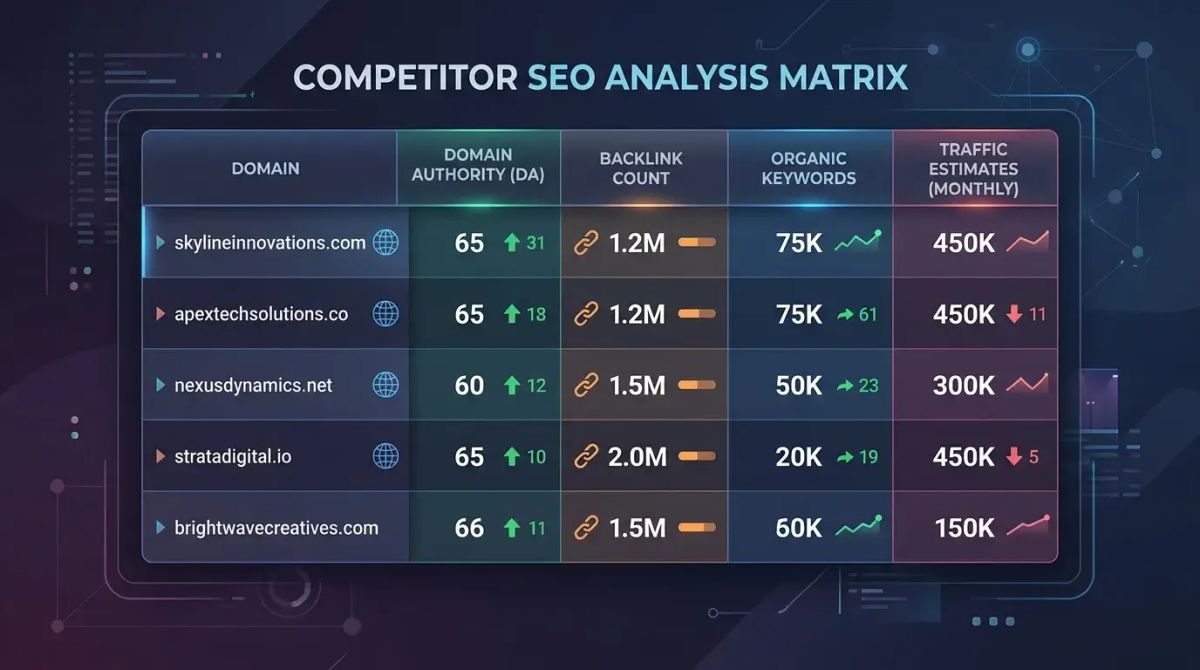
SEO competitor analysis is the systematic process of examining the strategies, performance, and tactics of websites that compete with yours for the same keywords and topics in search engine results. This analysis reveals which keywords your competitors rank for, what types of content they produce, where they acquire backlinks, and how their technical infrastructure is built.
The importance of competitor analysis manifests across multiple dimensions. First, it enables opportunity identification. You discover keywords that your competitors rank for but you have not yet targeted. Second, it provides threat assessment. You see the areas where your competitors are strong and can develop defensive strategies. Third, it drives resource optimization. You direct your limited budget and time toward the areas that will deliver the highest return. Fourth, it establishes benchmarks. You gain a measurement framework for comparing your own performance against your industry.
SEOctopus's Competitor AI Comparison module allows you to analyze your competitors' SEO performance with AI-powered insights and receive strategic recommendations instantly.
How to Identify Your Real SEO Competitors
Your SEO competitors and your business competitors are not always the same entities. A company that is your direct competitor in the business world may be targeting entirely different keywords in the digital landscape. Conversely, a blog or information portal in a completely different industry could be your biggest rival for the keywords you are targeting.
Follow these steps to identify your real SEO competitors:
Keyword-based competitor identification is the most effective approach. Search for your target keywords in search engines and list the sites that consistently appear on the first two pages. These are your real SEO competitors. Using SEOctopus's Keyword Discovery tool, enter your target keywords and automatically detect all competitors ranking for those terms.
Domain-based competitor identification allows you to analyze which keywords a specific competitor ranks for. This method reveals the competitor's entire organic keyword portfolio.
SERP overlap analysis measures which sites have the most SERP overlap with yours. The more shared keywords two sites rank for, the closer their competitive relationship.
After identifying your real SEO competitors, categorize them into three groups: direct competitors who offer the same products or services, indirect competitors who offer different products but rank for the same keywords, and SERP competitors who consistently appear for specific keyword clusters.
Keyword Gap Analysis
Keyword gap analysis is the process of identifying keywords that your competitors rank for but you do not. This analysis is the most direct indicator of your growth opportunities.
Three types of gaps exist. The first consists of keywords where your competitor ranks but you do not. These represent your biggest opportunities. The second includes keywords where both you and your competitor rank, but your competitor significantly outranks you. These are your improvement opportunities. The third covers keywords where you rank but your competitor does not. These are your competitive advantages that you need to protect.
When conducting gap analysis, follow these steps:
- Extract the complete organic keyword portfolios of your target competitors
- Compare them against your own keyword portfolio
- Analyze ranking differences for shared keywords
- Prioritize competitor-exclusive keywords by search volume and commercial value
- Create a content or optimization plan for each identified gap
SEOctopus's Competitor AI Comparison feature automatically identifies keyword gaps between two domains and provides AI-powered recommendations on which gaps are worth filling based on your site's current authority and the potential return on investment.
Content Gap Analysis
Content gap analysis provides a broader perspective than keyword gap analysis. It examines which topics your competitors cover, which content formats they use, and which subjects they have covered in depth.
Compare topic coverage. Examine your competitors' blog categories, guides, FAQ pages, and resource centers. Which topics have they covered comprehensively? Where have they remained shallow? This comparison produces a clear roadmap for your content strategy.
Analyze content depth. Examine the word count, heading structure, visual usage, data content, and user experience of your competitors' content on specific topics. More comprehensive and better-structured content generally ranks higher.
Compare content formats. Are your competitors producing blog posts, videos, infographics, or interactive tools? Which formats attract the most backlinks and engagement? This information helps you determine your own content mix.
Assess freshness. How frequently are your competitors' contents updated? How often do they publish new content? How consistent is their content calendar? Sites that maintain a consistent publishing cadence generally send stronger signals to search engines.
Backlink Profile Comparison
The backlink profile is one of the most important indicators of a site's authority level. Understanding your competitors' backlink profiles shapes your own link building strategy.
Start with total backlink count and quality. Total backlink numbers matter, but quality is more critical. A single backlink from a high-authority site is more valuable than hundreds of links from low-quality sites.
Referring domain diversity is another important metric. Hundreds of backlinks from the same site are not as valuable as hundreds from different sites. Examine how many unique domains link to your competitors.
Anchor text distribution reveals the naturalness of your competitors' link profiles. Excessively optimized anchor texts can signal a risky profile. A natural profile shows a balanced distribution of brand names, URLs, generic terms, and target keywords.
Link acquisition velocity indicates how many new backlinks your competitors gain per month. Sudden spikes may indicate artificial link building. Steady growth is a sign of a natural and sustainable profile.
SEOctopus's Backlink Analyzer module lets you examine your competitors' backlink profiles in detail, identify their high-authority sources, and shape your own link building strategy based on these insights.
Identify link opportunities. List sites that link to your competitors but not to you. These sites represent high-potential backlink sources for you as well. Sites that link to multiple competitors are especially high-priority targets.
Technical SEO Comparison
Technical SEO covers the infrastructure factors that affect how a site is crawled, indexed, and ranked by search engines. Understanding your competitors' technical SEO status reveals technical advantages or disadvantages on your own site.
Page speed and Core Web Vitals comparison is the starting point. Compare your LCP, FID, and CLS metrics against your competitors. In 2026, where Google places increasing importance on page experience in its rankings, these metrics are critical.
Mobile friendliness is another comparison area. How is your competitors' mobile experience? Do they use responsive design or have separate mobile sites? Because we are in the mobile-first indexing era, mobile experience has a direct impact on rankings.
Site architecture and internal linking analysis reveals how your competitors structure their content. Do they favor a flat structure or a deep hierarchy? What are their internal linking strategies? Are their URL structures clean and meaningful?
Schema markup usage shows your competitors' structured data implementation. Which schema types have they applied? Are they using FAQ schema, How-To schema, Product schema, and other types? This data helps you earn rich results in SERPs.
Indexation status shows how many of your competitors' pages are indexed and their indexing health. For very large sites, crawl budget management is important. Examine your competitors' sitemap structures and robots.txt configurations.
SERP Feature Analysis
Modern search engine results pages are no longer composed of just ten blue links. SERP features like featured snippets, People Also Ask boxes, knowledge panels, image results, and video carousels have become increasingly important.
Featured Snippet analysis identifies which keywords your competitors have won featured snippets for. Examine the content format they use to capture snippets. Paragraph snippets, list snippets, and table snippets require different optimization approaches.
People Also Ask (PAA) sections reveal questions where your competitors appear. PAA questions are a valuable source for understanding user intent and identifying content opportunities. Incorporating PAA questions into your content increases your chances of appearing in this section.
Knowledge panels appear for brand or entity-based searches. Gather information about the content, sources, and completeness of your competitors' knowledge panels. Use this data to create or improve your own knowledge panel.
Image and video results are claiming increasingly more SERP real estate. Examine how your competitors appear in search results with their visual and video content. Creating content optimized for these formats offers additional organic traffic opportunities.
AI and GEO Competitive Analysis
In 2026, search behavior has fundamentally changed. Fifty-two percent of users now use AI tools for information searches. ChatGPT, Perplexity, Google AI Overview, and other AI engines respond to users by summarizing content and citing sources. In this new environment, understanding how your competitors are treated by AI engines provides a critical competitive advantage.
AI citation analysis measures how frequently your competitors are cited as sources by AI engines. Which topics are they cited for? Which pages receive the most references? This information shapes your GEO strategy.
SEOctopus's GEO Monitor tool enables you to track your brand's and your competitors' visibility in AI engines. GEO Monitor shows which brands are cited for which queries across platforms like ChatGPT, Perplexity, and Google AI Overview, clearly revealing your competitive position.
AI content optimization comparison evaluates how well your competitors meet the preferences of AI engines. AI engines generally prefer content with these characteristics: clear and structured heading hierarchies, citable sentences and paragraphs, statistical and data-rich content, current and comprehensive information, and credible source references. Examine how well your competitors satisfy these criteria.
Brand mention analysis identifies how frequently your competitors are mentioned by name in AI responses. A competitor being consistently cited on a specific topic indicates strong authority signals in that area.
Competitor Content Strategy Analysis
Understanding your competitors' content strategies provides valuable insights for developing your own.
Publishing frequency shows how often your competitors produce new content. Are they publishing weekly, daily, or a few times per month? Examine the correlation between publishing frequency and organic traffic growth.
Content length and depth analysis is essential. What is your competitors' average content length? Do they favor long-form content or short summaries? Generally, longer and more comprehensive content attracts more backlinks and higher rankings.
Topic selection and trends reveal which subjects your competitors focus on. Which stages of the conversion funnel are they targeting? Are they producing more content at the awareness stage or the decision stage?
Content refresh strategy shows how frequently existing content is updated. Successful sites regularly update their best-performing content. Your competitors' refresh patterns should inform your own content update strategy.
Domain Authority and Authority Comparison
Domain Authority or similar authority metrics are comparative measures of a site's overall strength. While not a direct ranking factor, authority metrics serve as a useful indicator for assessing competition levels.
Domain Authority comparison allows you to compare your DA score against your competitors. The magnitude of the DA gap indicates the difficulty level of competing with that rival. Rather than directly competing for high-competition keywords against competitors with much higher DA, targeting lower-difficulty keywords may be more efficient.
Page Authority analysis makes authority comparisons at the page level. For ranking for a specific keyword, a competing page's PA score is a more meaningful metric than domain-level authority.
Topical Authority measures how deep and comprehensive a site's content is on a specific subject. If a competitor has dozens of interlinked pieces of content on a particular topic, they have built strong topical authority. This authority helps individual pages on that topic rank higher as well.
Page-Level Analysis: Top Pages and Traffic Estimation
Identifying your competitors' best-performing pages is the most direct way to spot opportunities.
Highest-traffic pages are the small number of pages that drive the majority of your competitors' organic traffic. The Pareto principle applies here: typically 20 percent of pages bring 80 percent of the traffic. Examine the topics, structure, and optimization tactics of these pages.
Newly rising pages show your competitors' content that has recently gained rankings rapidly. These pages reveal trending topics and effective optimization tactics.
Declining pages indicate areas where your competitors are losing rankings. These areas represent opportunity windows for you. By creating quality content on the topic of a competitor's declining page, you can capture those keywords.
Traffic estimation helps you understand which pages are most valuable by calculating the approximate organic traffic for each page. The topics of high-traffic pages determine your priority content targets.
Competitive Intelligence Tools and Resources
Using the right tools is essential for effective competitor analysis. When evaluating resources for competitor analysis in 2026, pay attention to these criteria: data accuracy, update frequency, scope of coverage, and ease of use.
SEOctopus offers a comprehensive solution for competitor analysis. With the Competitor AI Comparison module, you can analyze differences between two domains with AI-powered insights. Keyword Discovery reveals keyword gaps, Backlink Analyzer examines link profiles, and GEO Monitor compares visibility in AI engines. All of this data is consolidated in a single panel and transformed into actionable recommendations.
Google Search Console is a fundamental resource for monitoring your own performance. While it cannot show your competitors' data, it enables you to track your own ranking trends, click-through rates, and indexation status.
Google Trends shows the interest trends for specific keywords and topics over time. It is useful for evaluating the trending status of topics your competitors focus on.
SERP analysis tools enable you to examine search result pages in detail. They are used for featured snippet detection, SERP feature analysis, and tracking ranking changes.
From Competitor Analysis to Action Plan
After gathering competitor analysis data, transforming that data into an action plan is the most critical step. Data collection is not an end in itself; the goal is to derive strategic decisions from this data.
Create a prioritization matrix. Evaluate each opportunity along impact and effort axes. High-impact, low-effort opportunities should be implemented first. Low-impact, high-effort opportunities should be placed last.
Identify quick wins. Perform rapid optimizations for keywords where you are close to ranking but have not yet reached the first page. Title, meta description, and content updates for existing pages typically yield fast results.
Plan medium-term strategies. Create a content calendar for topics extracted from your content gap analysis. Produce a specific number of new pieces each month and update existing content.
Set long-term goals. Increasing Domain Authority, building topical authority, and strengthening your backlink profile require long-term work. Set six-month and annual targets.
Continuous Competitive Monitoring
Competitor analysis is not a one-time exercise. The competitive landscape is constantly changing, and your strategy must adapt accordingly.
Weekly monitoring tracks ranking changes for your critical keywords. A competitor's sudden rise or fall may signal a change in their strategy.
Monthly reporting produces a comprehensive competitor performance report. Document keyword portfolio changes, new content, backlink acquisitions, and technical changes.
Quarterly strategic review revisits your competitor analysis. New competitors may have emerged, existing competitors may have shifted strategies, or market dynamics may have changed.
SEOctopus's GEO Monitor and Competitor AI Comparison modules let you automate competitive monitoring. These modules automatically detect changes in your competitors' SEO and GEO performance and send you notifications so you can respond quickly to your competitors' moves.
Frequently Asked Questions
How often should SEO competitor analysis be performed?
A comprehensive competitor analysis should be conducted quarterly. However, elements like keyword ranking tracking and new content monitoring should be checked weekly. In highly competitive industries, monthly deep-dive analyses may also be necessary. SEOctopus's Competitor AI Comparison and GEO Monitor tools enable continuous monitoring so you can respond to changes instantly.
Why might my business competitors differ from my SEO competitors?
A company that is your direct competitor in the business world may be targeting entirely different keywords in the digital landscape. For example, a consulting firm's SEO competitor might be a media site that blogs about the same topics rather than another consulting firm in the same sector. Sites that consistently compete with you for the same keywords in SERPs are your real SEO competitors.
What is the difference between keyword gap analysis and content gap analysis?
Keyword gap analysis focuses on specific keywords and identifies terms where your competitor ranks but you do not. Content gap analysis takes a broader perspective, comparing topics, content formats, content depth, and topic coverage. Both complement each other and should be applied together for the best results.
Should I copy my competitor's backlink profile?
Rather than copying directly, analyze your competitor's backlink profile to identify opportunity sources. You can reach out to some of the sites that link to your competitor, but do not try to make your link profile identical to theirs. A natural and diverse link profile is always healthier. SEOctopus's Backlink Analyzer tool lets you examine your competitors' link sources and shape your own strategy accordingly.
How can I track my competitors in AI engines?
In 2026, visibility in AI engines is critically important. Query your target keywords in platforms like ChatGPT, Perplexity, and Google AI Overview to see which brands are cited. SEOctopus's GEO Monitor tool automates this process and regularly reports your competitors' visibility in AI engines.
What should be the first step after competitor analysis?
The first step is to place the collected data into a prioritization matrix. Identify opportunities that create high impact with low effort. Typically, optimizing existing content and targeting keywords that are close to ranking yields the fastest results. Then, create a content calendar for topics identified from your content gap analysis.
How do I compete with a rival whose Domain Authority is much higher than mine?
When the Domain Authority gap is large, competing directly for high-competition keywords is difficult. Instead, focus on long-tail keywords, build topical authority in niche subjects, and gradually increase your DA over time. Quality content and natural backlink acquisition will close the DA gap over time. Additionally, deepening your content on specific niche topics can give you a topical authority advantage.
Conclusion
SEO competitor analysis is an indispensable component of a successful digital marketing strategy. Understanding what your competitors are doing is essential for strengthening your own strategy, identifying opportunities, and protecting against threats. In 2026, AI and GEO competition have been added alongside traditional SEO competition. Monitoring and analyzing your competitors in both search engines and AI engines is mandatory for sustainable organic growth. With SEOctopus's Competitor AI Comparison, GEO Monitor, Backlink Analyzer, and Keyword Discovery tools, you can manage your competitor analysis comprehensively, data-driven, and action-oriented.