Local SEO Guide: Dominate Regional Rankings with Google Business Profile (2026)
Local SEO Guide: Dominate Regional Rankings with Google Business Profile (2026)
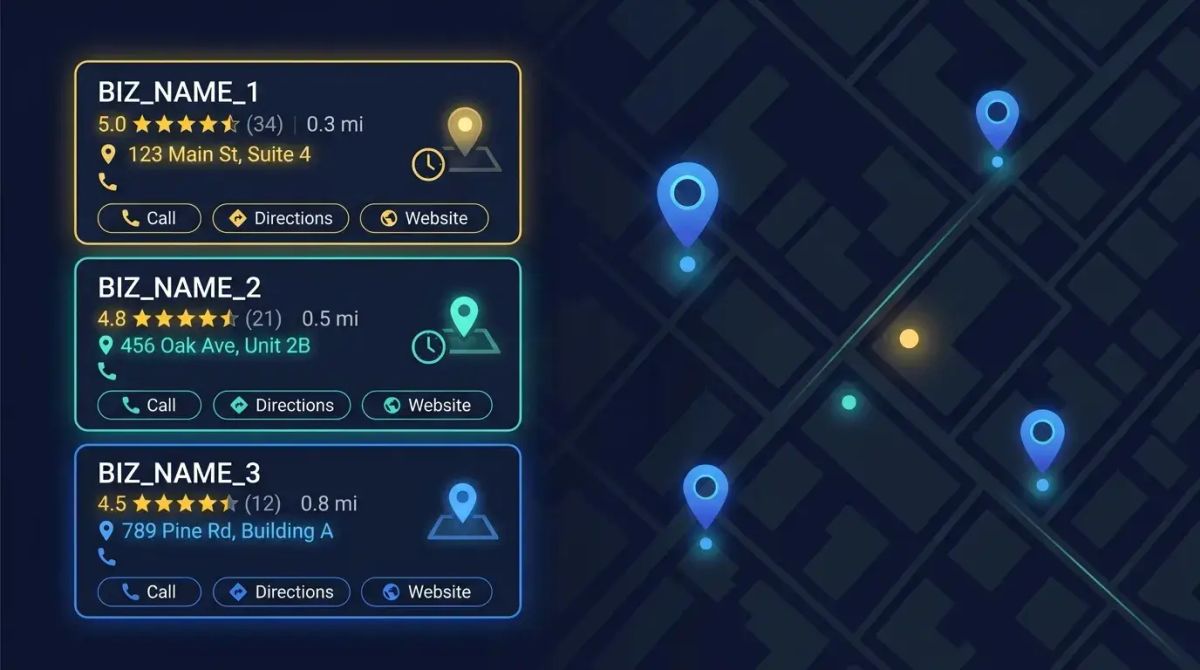
Local SEO is the practice of optimizing your online presence to attract customers from relevant local searches. When someone types "coffee shop near me," "dentist in Brooklyn," or "best plumber in Austin," local SEO determines which businesses appear in those results. For any business with a physical location or serving a specific geographic area, local SEO is not optional — it is essential.
The numbers back this up decisively. In 2026, 46 percent of all Google searches carry local intent. "Near me" searches have grown by 150 percent over the past two years. 78 percent of local mobile searches result in an offline purchase within 24 hours. Businesses appearing in the Local Pack (the top three map results) receive five times more clicks than standard organic listings.
What is Local SEO and How Does It Differ from Traditional SEO?
Traditional SEO focuses on improving your website's visibility in organic search results regardless of location. Local SEO, on the other hand, targets searches with geographic intent and aims to position your business in Google Maps, the Local Pack, and location-based organic results.
Google uses three primary signals for local rankings: relevance, distance, and prominence. Relevance measures how well your business listing matches the search query. Distance calculates how far your business is from the searcher's location. Prominence reflects your business's overall reputation, including reviews, citations, and link authority.
Understanding this distinction is critical because local SEO requires a different set of tactics. While traditional SEO emphasizes content, backlinks, and technical optimization, local SEO adds layers like Google Business Profile management, NAP consistency, local citations, and review management.
Google Business Profile Optimization
Your Google Business Profile (formerly Google My Business) is the single most important factor in local SEO. This free listing appears directly in Google Maps and Google Search results, making it the first impression most local customers will have of your business.
Complete every field in your profile. Google favors fully completed profiles. Fill in your business name, address, phone number, website, hours of operation, categories, and business description. Use your primary keywords naturally within the business description without keyword stuffing.
Choose the right categories. Your primary category has the biggest impact on which searches trigger your listing. Be specific — choose "Italian Restaurant" rather than "Restaurant." Add secondary categories to cover additional services you offer.
Upload high-quality photos regularly. Businesses with photos receive 42 percent more requests for driving directions and 35 percent more click-throughs to their websites. Add exterior shots, interior photos, product images, and team pictures. Update them monthly to signal an active, thriving business.
Publish Google Posts weekly. Google Posts appear directly in your business listing and can highlight promotions, events, new products, and blog articles. Regular posting signals to Google that your business is active and engaged. Each post should include a clear call-to-action.
Manage the Q&A section proactively. Seed the Q&A section with common questions and detailed answers. This not only helps potential customers but also adds keyword-rich content to your profile. Monitor for user-submitted questions and respond promptly.
NAP Consistency: The Foundation of Local Trust
NAP stands for Name, Address, and Phone number. Maintaining consistent NAP information across the entire internet is fundamental to local SEO success. Google cross-references your NAP data across hundreds of sources to verify your business identity and legitimacy.
Inconsistencies confuse search engines and erode trust. If your business is listed as "Smith & Associates Law Firm" on your website but "Smith Associates Law" on Yelp and "Smith and Associates" on the Yellow Pages, Google may treat these as separate entities or lower your rankings due to uncertainty.
To maintain NAP consistency: audit all your existing online listings, standardize your business name format, use the exact same address format everywhere (decide on "Street" vs "St." and stick with it), include the area code in your phone number consistently, and update any listing that has moved or changed. SEOctopus's site audit feature can help detect NAP inconsistencies across your web presence and provide actionable recommendations.
Local Citations and Directory Listings
Local citations are mentions of your business's name, address, and phone number on other websites. They serve as votes of confidence that tell Google your business is real and legitimate.
Structured citations come from business directory listings. Prioritize major platforms like Yelp, Bing Places, Apple Maps, Facebook Business, Foursquare, and industry-specific directories. For example, restaurants should be listed on TripAdvisor and OpenTable, while medical practices should claim their Healthgrades and Zocdoc listings.
Unstructured citations occur when your business is mentioned in blog posts, news articles, or social media without a formal directory listing format. Local newspapers, community blogs, and industry publications are valuable sources of unstructured citations.
Build your citation profile strategically: start with the major general directories, then move to industry-specific directories, and finally target local and niche directories. After each submission, verify that the information published matches your standardized NAP data exactly.
Local Keyword Research
Local keyword research requires a different approach than traditional keyword research. Your focus should be on terms that combine services with geographic modifiers and local intent signals.
Add geographic modifiers. Instead of targeting "personal injury lawyer," target "personal injury lawyer in Denver," "Denver personal injury attorney," and "best personal injury lawyer near downtown Denver." Create variations at the city, neighborhood, and district level.
Target "near me" queries. "Near me" searches are predominantly mobile and carry extremely high purchase intent. Ensure your Google Business Profile and website are optimized to appear for these queries through proper location signals and mobile optimization.
Find long-tail local keywords. Queries like "emergency plumber open on Sunday in north Austin" have low competition and extremely high conversion rates. Use these in blog content, FAQ pages, and service area pages.
Mine local search suggestions. Google Autocomplete and the "Related searches" section at the bottom of search results reveal real user behavior patterns. Type your core service terms followed by your location and note the suggestions Google provides.
Reviews and Reputation Management
Customer reviews are among the most powerful ranking factors in local SEO. Google explicitly uses review quantity, quality (average star rating), and recency in its local ranking algorithm. Beyond rankings, reviews heavily influence consumer decision-making — 93 percent of consumers say online reviews impact their purchasing decisions.
Develop a systematic review generation strategy. Ask customers for reviews after positive interactions. Use follow-up emails, SMS reminders, or QR code cards that link directly to your Google review page. Make the process as frictionless as possible — one click should open the review form.
Respond to every review. Thank positive reviewers with personalized responses. Address negative reviews professionally and with a solution-oriented approach. Your responses are public and influence how potential customers perceive your business. Naturally incorporate relevant keywords in your responses where appropriate.
Turn negative reviews into opportunities. Respond quickly and empathetically to complaints. Offer to resolve the issue offline. Many dissatisfied customers will update their review after a positive resolution. Potential customers who see you handling criticism professionally gain confidence in your business.
Local Link Building
Local backlinks — links from websites in your geographic area — send strong signals to Google about both your domain authority and local relevance.
Key local link building opportunities include: local chamber of commerce and business association websites, sponsoring local events (charity runs, community festivals, school programs), partnerships with local nonprofits and charitable organizations, regional news outlets and local newspapers, cross-referrals with complementary local businesses, university and educational institution websites, and local government resource pages.
Create locally relevant content to earn links. Write neighborhood guides, local event roundups, or "best of" lists for your area. Participate in or host community events and publish content about them. Build relationships with local journalists and bloggers who may reference your expertise.
Schema Markup for Local Businesses
Schema markup provides search engines with structured, machine-readable information about your business. For local businesses, implementing the right schema types can directly influence your search appearance and click-through rates.
Use LocalBusiness schema to markup your business name, address, phone number, operating hours, geographic coordinates, accepted payment methods, and price range. Implement it in JSON-LD format, which Google recommends:
```json
{
"@context": "https://schema.org",
"@type": "LocalBusiness",
"name": "Business Name",
"address": {
"@type": "PostalAddress",
"streetAddress": "123 Main Street",
"addressLocality": "City",
"addressRegion": "State",
"postalCode": "12345",
"addressCountry": "US"
},
"telephone": "+1-555-555-5555",
"openingHoursSpecification": {
"@type": "OpeningHoursSpecification",
"dayOfWeek": ["Monday","Tuesday","Wednesday","Thursday","Friday"],
"opens": "09:00",
"closes": "18:00"
},
"geo": {
"@type": "GeoCoordinates",
"latitude": "40.7128",
"longitude": "-74.0060"
}
}
```
Add Organization schema at the brand level to include your logo, social media profiles, and founding information. Implement FAQ schema for your frequently asked questions to earn rich results in search. Use Review schema to display star ratings directly in search results, increasing click-through rates significantly.
Google Maps Optimization
Google Maps is the most viewed section of local search results, and optimizing for it goes beyond your Google Business Profile.
Verify your pin location accuracy. Your business pin must be in the exact correct position on the map. An incorrect pin leads to frustrated customers who cannot find you, resulting in negative experiences and potentially bad reviews.
Add photos and virtual tours. 360-degree virtual tours increase user engagement by 40 percent. Google Street View compatible virtual tours can be created by certified photographers and provide an immersive preview of your business.
Keep your information current. Update special hours (holidays, seasonal changes), temporary closures, and new services immediately. Google rewards profiles that remain accurate and up-to-date with higher trust scores.
Encourage map interactions. When customers save your location, share it with friends, or leave reviews directly on Maps, these engagement signals boost your Maps ranking.
Mobile Optimization for Local Search
Over 60 percent of local searches happen on mobile devices. Your website's mobile experience directly impacts your local SEO performance and conversion rates.
Adopt a mobile-first design philosophy. Responsive design is the absolute minimum. Page load time must be under 3 seconds. Include click-to-call phone number buttons. Integrate maps with one-tap driving directions. Make your address and hours immediately visible without scrolling.
Optimize Core Web Vitals. LCP (Largest Contentful Paint) should be under 2.5 seconds, FID (First Input Delay) under 100 milliseconds, and CLS (Cumulative Layout Shift) below 0.1. SEOctopus's technical SEO audit tool can monitor these metrics continuously and flag issues before they impact your rankings.
Eliminate mobile usability issues. Test your site on multiple devices and screen sizes. Avoid intrusive interstitials (pop-ups) that cover content on mobile. Ensure buttons and links have adequate tap targets (at least 48x48 pixels). Use legible font sizes without requiring pinch-to-zoom.
Local SEO for Multiple Locations
Managing local SEO for businesses with multiple locations requires a scalable strategy that maintains quality across every listing.
Create separate Google Business Profiles for each location. Each profile must have its own unique address, phone number, and hours. Manage all profiles under one organizational account for efficiency.
Build unique location pages on your website. Each branch needs its own dedicated page with unique content — not duplicated templates. Include location-specific information such as staff bios, neighborhood descriptions, local testimonials, and unique services. Use a hierarchical URL structure like "/locations/new-york-brooklyn/" for clarity.
Implement a centralized management approach. Manage NAP information for all locations from a single source of truth. Standardize your review monitoring and response process. SEOctopus's multi-project management feature allows you to track SEO performance across all your locations from one dashboard, making it efficient to spot issues and opportunities at any branch.
Tracking Local Rankings
Measuring the results of your local SEO efforts requires tracking the right metrics consistently.
Core local SEO metrics to monitor: Local Pack ranking positions, Google Maps visibility, organic local search rankings, Google Business Profile views and interactions, driving direction requests, phone calls from your listing, and website clicks from your profile.
Track rankings by specific location. SEOctopus's keyword tracking feature lets you monitor ranking positions at the city or district level. Compare search results from different locations to understand how your visibility varies geographically.
Analyze Google Business Profile insights. Review the search queries triggering your profile, the number of views and interactions, and which photos generate the most engagement. Use these insights to refine your optimization strategy.
Conduct regular competitor analysis. Monitor your local competitors' Local Pack rankings, review counts, and profile activity. Identify their weaknesses and capitalize on gaps in their strategy.
Frequently Asked Questions
How long does it take to see local SEO results?
Local SEO results typically become visible within 3 to 6 months. Google Business Profile optimizations and review generation can show faster results, while local link building and content strategies are longer-term investments that compound over time.
Is Google Business Profile free?
Yes, Google Business Profile is completely free to create and manage. After claiming your business, you can verify it through a postcard, phone call, or email verification process, which usually takes a few days to complete.
Do I need a separate profile for each business location?
Yes, every physical location requires its own Google Business Profile with its unique address, phone number, and operating hours. Managing multiple profiles under one account is straightforward and recommended.
Can I remove negative reviews from my Google profile?
You can report reviews that violate Google's policies (spam, hate speech, fake reviews, off-topic content) and request removal. However, legitimate negative reviews cannot be deleted. The most effective strategy is to respond professionally and demonstrate your commitment to customer satisfaction.
What is the difference between local SEO and traditional SEO?
Traditional SEO focuses on ranking your website in organic results regardless of location. Local SEO targets geographically relevant searches and focuses on Google Maps, the Local Pack, and location-based results. Local SEO requires additional tactics like Google Business Profile optimization, NAP consistency, local citations, and review management.
How does SEOctopus help with local SEO?
SEOctopus enables you to track local keyword rankings at the city and district level, run technical SEO audits to identify mobile and speed issues, and analyze your competitors' local performance. The multi-project dashboard lets you manage multiple locations efficiently from a single interface.
Conclusion
Local SEO is a non-negotiable strategy for every business with a physical presence. The combination of Google Business Profile optimization, NAP consistency, local citations, review management, schema markup, and mobile optimization creates a comprehensive approach that drives real foot traffic and revenue. By implementing the strategies outlined in this guide systematically, you can dominate local search results in your area and connect with customers at the moment they are ready to buy. With SEOctopus's suite of tools, you can manage your local SEO process efficiently and track your progress with concrete data.