Schema Markup and Structured Data Guide: Win Rich Results with JSON-LD (2026)
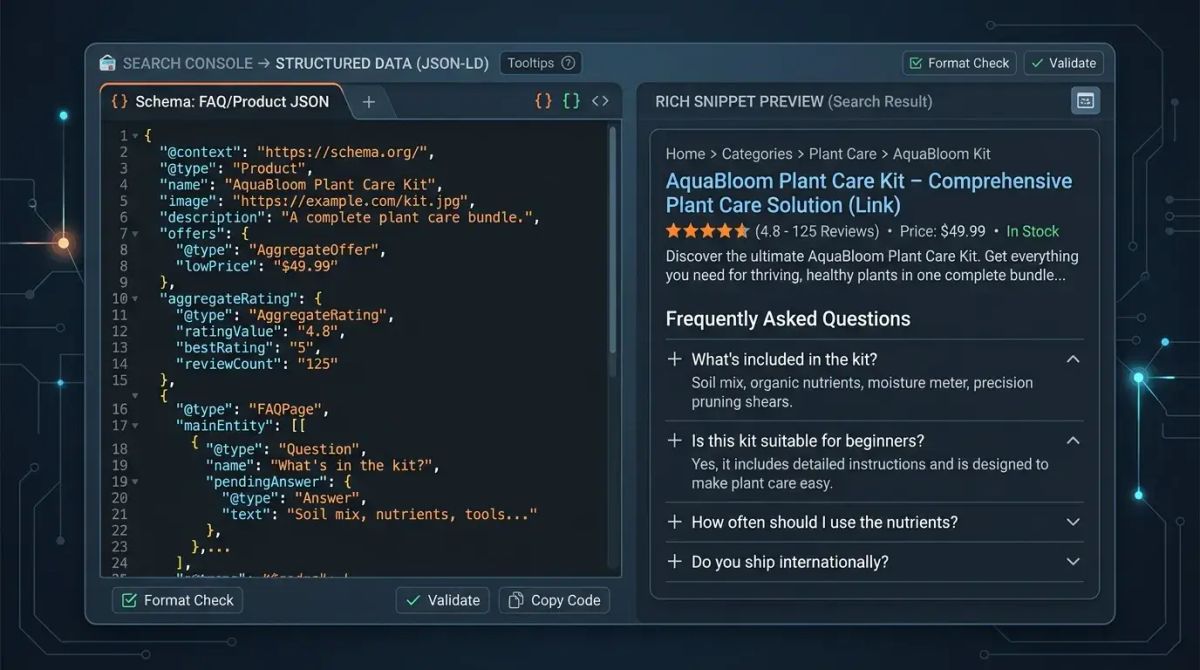
Schema Markup and Structured Data Guide: Win Rich Results with JSON-LD (2026)
Search engines rely heavily on structured data to understand web content. Crawling HTML and extracting meaning from headings and paragraphs is not always sufficient for accurate interpretation. Schema markup is the standardized way to explicitly tell search engines what your content is about. According to 2026 data, pages using schema markup achieve an average 40 percent higher click-through rate compared to pages without it. Furthermore, AI engines like ChatGPT, Gemini, and Perplexity use structured data as a priority signal when selecting sources for their responses.
In this guide, we will cover everything from the concept of schema markup to JSON-LD implementation, from rich result types to optimization for AI engines.
What Is Schema Markup?
Schema markup is a structured data vocabulary that allows you to label the content on your web pages for search engines. Developed by Schema.org and jointly supported by Google, Bing, Yahoo, and Yandex, this standard enables you to define the type, properties, and relationships of your content.
For example, if you have a recipe page, schema markup lets you explicitly tell search engines that this page is a recipe, the cooking time is 30 minutes, the calorie count is 450, and the user rating is 4.8. This information appears as rich results in search listings and attracts user attention.
Schema markup does not change the content itself. Users see no difference on your page. However, search engines read this additional information and create a richer presentation in search results.
Why Structured Data Is Critical for SEO
The impact of structured data on SEO manifests across multiple layers.
Rich results and increased click-through rates are the most visible benefit. Star ratings, price information, FAQ expandables, and recipe details attract significantly more attention than standard blue links. Research shows that rich results increase click-through rates by 20 to 60 percent.
Better content comprehension by search engines is another critical benefit. Google's Knowledge Graph and AI-powered search features feed on structured data. When you properly label your content, search engines grasp your topics, entities, and relationships far more accurately.
Source prioritization for AI engines is one of the most important benefits in 2026. AI search engines like ChatGPT, Gemini, and Perplexity prefer sources with rich structured data when generating responses. Pages using schema markup receive 35 percent more visibility in AI citations.
Voice search compatibility is another advantage provided by structured data. Voice assistants use structured data to generate direct answers. FAQ and HowTo schemas are particularly effective for voice search queries.
JSON-LD vs Microdata vs RDFa: Which Format Should You Choose?
Schema markup can be implemented in three different formats. Each has its own advantages and disadvantages.
JSON-LD (Recommended)
JSON-LD is the format officially recommended by Google. It stands for JavaScript Object Notation for Linked Data. It sits independently from the page's HTML structure within a script tag.
```json
```
The advantages of JSON-LD include independence from HTML structure, easy maintenance, simple dynamic generation, and being preferred by Google.
Microdata
Microdata uses attributes added directly to HTML elements. It works with itemscope, itemtype, and itemprop attributes.
```html
Schema Markup Guide
SEO Expert
```
The disadvantage of Microdata is its tight coupling with HTML. When you change the page design, you also need to update the structured data.
RDFa
RDFa is added to HTML elements similarly to Microdata but uses a more complex syntax. It is generally preferred in academic and enterprise projects.
The recommended format is JSON-LD. Google explicitly states its preference for it, implementation is easier, and it has no dependency on the page's visual structure. All examples in the remainder of this guide will use JSON-LD format.
Common Schema Types and JSON-LD Examples
Article Schema
Used for blog posts, news articles, and features. Increases your chances of appearing in Google Discover and Google News.
```json
```
FAQ Schema
Used for frequently asked questions. Displayed as question-answer expandables in search results, significantly increasing your page's visual real estate.
```json
```
HowTo Schema
Used for step-by-step instructions. Displayed as numbered steps in search results.
```json
```
Product Schema
A critical schema type for e-commerce pages. Displays price, availability, and user reviews in search results.
```json
```
LocalBusiness Schema
Displays address, business hours, and contact information for local businesses in search results.
```json
```
Organization Schema
Communicates general information about your organization to search engines. Includes logo, social media profiles, and contact information.
```json
```
BreadcrumbList Schema
Defines navigation paths that show page hierarchy in search results. Helps users find what they are looking for more easily.
```json
```
Review Schema
Defines product or service reviews in a structured format. Enables star ratings to appear in search results.
```json
```
Rich Results and Their Impact on Click-Through Rates
Rich results are search results that feature additional visual elements and information compared to standard results. When you implement schema markup, Google can display the following rich result types:
- FAQ rich results: Question-answer expandables can double your page's real estate in search results
- Star ratings: Product and service reviews increase user trust
- Price information: Attracts purchase-intent users for e-commerce pages
- Recipe cards: Displays cooking time and calorie information for recipe pages
- Event information: Presents date, time, and location directly in search results
- HowTo steps: Presents step-by-step instructions in a compact visual format
According to research, rich results achieve an average 58 percent higher click-through rate compared to standard results. This difference is even more pronounced in mobile search because visually rich results attract significantly more attention in screen-limited environments.
SEOctopus's Technical SEO Audit tool analyzes your site's current schema markup status and identifies missing or erroneous structured data. It provides reports recommending which schema types should be used on which pages.
Schema Markup and AI Engines
In 2026, structured data is critical not only for traditional search engines but also for AI engines. AI-based search systems like ChatGPT, Gemini, Perplexity, and Claude leverage structured data extensively in their content extraction and citation processes.
How do AI engines use structured data?
When AI engines generate a response to a query, they gather sources from the web. In this process, sources with rich structured data have several advantages. First, AI engines clearly understand the content type and scope. Second, they leverage Organization and Person schemas to evaluate author and publisher credibility. Third, FAQ schemas provide direct question-answer mapping, making it easier for AI to produce precise answers.
Recommendations for structured data optimization for AI:
- Complete all author and publisher fields in Article schema
- Mark up frequently asked questions and answers with FAQ schema
- Strengthen brand credibility signals with Organization schema
- Specify content freshness with the dateModified field
- Use comprehensive description fields to make it easier for AI to summarize your content
How to Implement JSON-LD: Step by Step
Step 1: Analyze Your Page Content
First evaluate your page content and determine the appropriate schema types. A blog post requires Article, a product page requires Product, and a business page requires LocalBusiness schema. SEOctopus's On-Page Checker tool automatically detects which schema types are missing from your page.
Step 2: Determine Required Properties
Each schema type has required and recommended properties. Check Google's documentation to learn which fields are mandatory. For example, Article requires headline, author, and datePublished.
Step 3: Write the JSON-LD Code
Write your determined schema type and properties in JSON-LD format. You can use the examples above as a foundation.
Step 4: Add to Your Page
Add the JSON-LD code within a script tag to your page's head or body section. If you are using Next.js, you can add it through the Head component or the metadata API.
Step 5: Test and Validate
Verify that your structured data works correctly using Google Rich Results Test and Schema.org Validator tools.
Testing Tools
Several important tools are available for testing your structured data.
Google Rich Results Test checks whether your structured data triggers rich result types recognized by Google. You can test by entering a live URL or pasting HTML code.
Schema.org Validator checks whether your structured data conforms to schema.org standards. As a general validation tool that is not specific to Google, it supports all schema types.
Google Search Console Rich Results Report shows your site's current rich result status, errors, and warnings. You can track which pages have been successfully indexed as rich results.
SEOctopus Technical SEO Audit analyzes the schema markup status across all pages of your site in bulk. It automatically detects missing, erroneous, or optimizable structured data and provides correction recommendations.
Common Mistakes
Many common mistakes are made when implementing schema markup. Knowing and preventing these mistakes significantly increases your chances of obtaining rich results.
Using schema that does not match the visible content on the page is the most common mistake. Google requires that the information in schema be consistent with the content visible on the page. Displaying 4.2 stars on the page while writing 4.8 in the schema can lead to penalties.
Omitting required fields is another frequent mistake. Each schema type has specific mandatory properties. Leaving these fields empty can cause the structured data to be completely ignored.
Using the wrong schema type prevents your content from being correctly identified. Adding Product schema to a blog post or placing Article schema on a product page generates errors.
Including outdated information also creates problems. When prices change, stock runs out, or business hours are updated, do not forget to update the schema as well.
Using multiple conflicting schemas confuses search engines. Avoid using schemas with contradictory information on the same page.
Advanced: Nested Schemas
One of the powerful features of schema markup is the ability to use nested structures. Within an Article schema, you can use a Person schema as the author, an Organization schema as the publisher, and reference FAQ content within the same entity.
```json
```
Nested schemas provide search engines with richer and more contextual information. Linking author information to the organization they work for strengthens E-E-A-T signals.
Advanced: Event Schema
Event schema is used to display date, time, location, and ticket information for events in search results.
```json
```
Advanced: Video Schema
Video schema enables video content to appear in search results with a thumbnail, duration, and upload date. It is especially important for video content hosted outside of YouTube.
```json
```
Conclusion
Schema markup is an indispensable part of your SEO strategy in 2026. You should implement structured data to increase your click-through rates with rich results, stand out as a source in AI engines, and help search engines better understand your content. JSON-LD format is the easiest and most effective method. Properly implementing fundamental schema types like Article, FAQ, HowTo, Product, LocalBusiness, and Organization makes a significant difference.
SEOctopus's Technical SEO Audit and On-Page Checker tools automate your structured data analysis, enabling you to detect missing or erroneous schemas. Test your structured data implementation, monitor it, and continuously optimize.
Frequently Asked Questions
Is schema markup a ranking factor?
Schema markup is not a direct ranking factor. However, rich results increase click-through rates, which indirectly has a positive impact on rankings. Additionally, AI engines use structured data as a priority signal in source selection. Google states that structured data improves the content understanding process and helps deliver accurate results.
Can I use multiple schemas on a single page?
Yes, you can use multiple schemas on a single page. For example, using Article, FAQ, and BreadcrumbList schemas together on a blog post is a common practice. You can place each schema in a separate script tag or combine them within a single script tag using the @graph property.
Does adding schema markup affect site speed?
JSON-LD script tags are very small in size and have virtually no impact on page performance. A typical schema markup code ranges from 1 to 3 KB. This amount does not create a measurable effect on page load time. The Microdata format can create a minimally larger HTML size because it adds additional attributes to HTML, but this is also negligible.
How do I add schema markup to WordPress?
For WordPress, plugins like Yoast SEO, Rank Math, and Schema Pro automatically generate schema markup. For custom schema requirements, you can manually add JSON-LD code to the head section of your theme files. You can also programmatically add schema using the wp_head hook.
How long does it take for schema markup to work?
After adding schema markup, Google needs to recrawl and reindex your page. This process can take anywhere from a few days to a few weeks. You can monitor the rich results report in Google Search Console to see whether your schema has been successfully recognized. To speed up crawling, you can request reindexing through URL inspection in Search Console.
Can I get penalized for using incorrect schema markup?
Intentionally using misleading schema markup violates Google's structured data guidelines and can result in manual action. For example, adding fake star ratings, displaying product prices that do not exist on the page, or using schema inconsistent with the content are grounds for penalties. However, unintentional technical errors generally do not lead to penalties but only to rich results not being displayed. SEOctopus's Technical SEO Audit tool automatically detects such inconsistencies and alerts you.
Which schema types are most effective for AI engines?
The most effective schema types for AI engines are FAQ, Article, HowTo, and Organization schemas. FAQ schema provides direct question-answer mapping, making it easier for AI to generate precise answers. Article schema provides credibility signals through author and publisher information. Organization schema defines brand authority. HowTo schema enables the structuring of step-by-step instructions.