SEO for Startups: The Complete Guide to Organic Growth from Day One (2026)
SEO for Startups: The Complete Guide to Organic Growth from Day One (2026)
When you launch a startup, you face an overwhelming array of growth channels: paid advertising, social media marketing, influencer partnerships, events, and more. Most of these channels share one fundamental limitation — they only work while you are spending money. Turn off the budget and the traffic disappears overnight. SEO operates on an entirely different principle. The investment you make in SEO today continues to generate compounding returns for months and years to come. A single blog post can drive organic traffic for years, and a well-optimized product page consistently attracts qualified leads without any additional spend.
In 2026, organic search remains the single largest source of web traffic. According to BrightEdge data, more than 53 percent of all web traffic originates from organic search. For startups, this represents an opportunity too significant to ignore. Yet many founders place SEO on the "we will do it later" list, and this delay creates a competitive disadvantage that becomes increasingly difficult to overcome. In this guide, we will walk through exactly how startups can leverage SEO as a strategic growth channel from day one, covering everything from technical foundations to measuring ROI.
Why Startups Must Start SEO from Day One
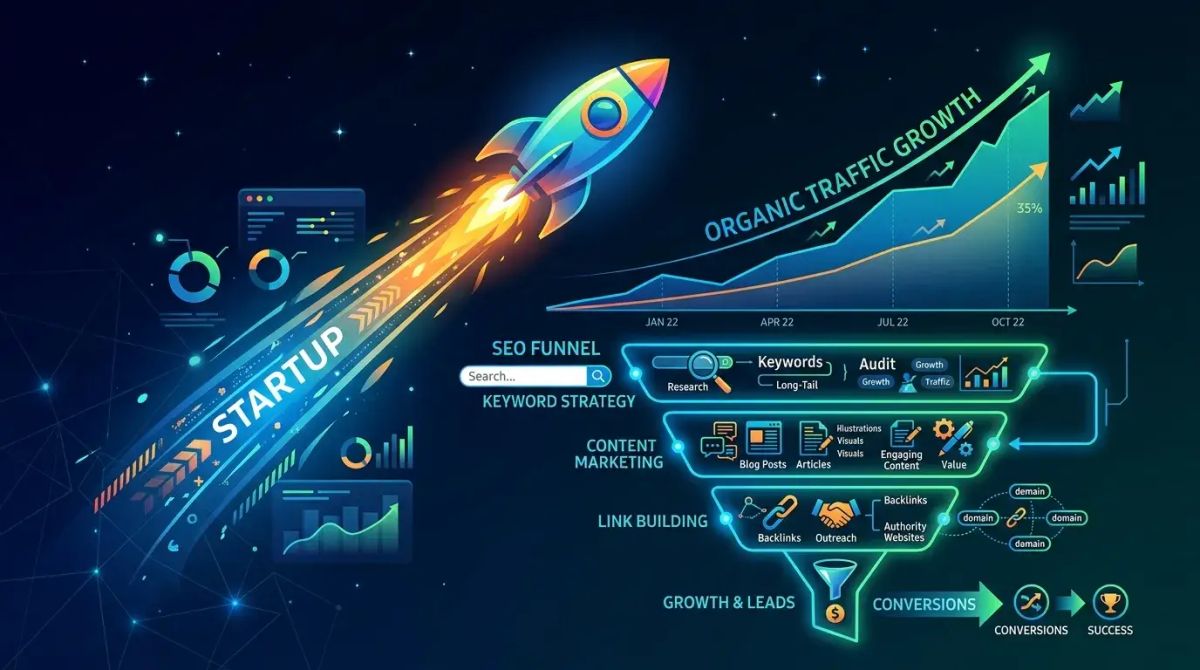
The most powerful characteristic of SEO is its compounding nature. When you create content and build your technical infrastructure correctly, your organic traffic grows month over month in an exponential curve. A blog post that drives 100 visitors in month three might drive 500 in month six and 2,000 in month twelve. This is the complete opposite of paid advertising, which delivers linear returns that stop the moment you stop spending.
Starting early also builds domain authority. Search engines evaluate how long a website has been active, how much content it has produced, and how many quality backlinks it has accumulated. A startup that begins SEO on day one gains a serious advantage over competitors who start six months later. Trust and authority signals in Google's algorithms accumulate over time, and there is no shortcut to accelerate this process.
Furthermore, early-stage SEO serves as a powerful product-market fit validation tool. Through keyword research, you learn what people are actually searching for, what problems they are trying to solve, and what language they use to describe those problems. These insights directly inform your product development decisions. Using an affordable SEO tool like SEOctopus, you can discover keyword opportunities from the very first day and shape your strategy based on real data rather than assumptions.
SEO vs Paid Acquisition: The Case for Sustainable Growth
Startups typically gravitate toward Google Ads or Meta Ads because they deliver immediate results. This is understandable — paid advertising provides instant traffic and conversions. However, when you examine the long-term cost dynamics, the picture changes dramatically.
The Challenges of Paid Acquisition
Customer acquisition cost (CAC) through paid channels increases over time. As more competitors bid on the same keywords, cost per click (CPC) rises. In 2026, average CPCs in many industries have more than doubled over the past five years. Additionally, when your advertising budget runs out, traffic drops to zero instantly. This creates a dangerous dependency for startups with limited runway.
The SEO Advantage
SEO operates on an inverse dynamic. After the initial investment, marginal cost decreases. The time and money you spend writing a blog post is a fixed cost, but that post continues to drive traffic for years. Customer acquisition cost through organic channels is typically one-third to one-fifth of paid channels. Moreover, organic traffic tends to be higher quality because users are actively seeking information and have chosen to click on your content because they found it trustworthy and relevant.
The Optimal Approach
The most effective strategy combines both channels. In the short term, generate revenue through paid advertising while simultaneously building your SEO infrastructure. As your organic traffic grows, gradually reduce your advertising spend. Many successful startups have executed this transition strategy, making organic traffic their primary growth channel within 12 to 18 months.
Limited Budget SEO Strategy
Budget is the biggest constraint for startups. Large enterprises can allocate thousands of dollars monthly to SEO, but an early-stage startup does not have that luxury. However, limited budget does not mean ineffective SEO. With proper prioritization, you can achieve maximum impact with minimal spend.
Priority Order
The first priority is establishing correct technical SEO foundations. This requires no money — only knowledge and time. The second priority is producing content targeting low-competition keywords. The third priority is organic link building activities. Instead of subscribing to multiple expensive SEO tools, use an all-in-one platform like SEOctopus that offers startup-friendly pricing. With a single tool, you can handle SERP tracking, keyword analysis, content optimization, and competitor monitoring.
The DIY SEO Approach
In the early stages, doing SEO yourself rather than outsourcing is far more efficient. As a founder, nobody understands your industry, customers, and product better than you do. This knowledge is the most valuable raw material for creating effective content. Learning SEO fundamentals takes a few weeks, and this investment pays returns throughout the lifetime of your company.
Technical SEO Foundations for New Sites
Technical SEO is the foundation of your house. If the foundation is not solid, nothing you build on top will stand properly. When building a new startup website, these are the technical SEO elements you must get right.
Site Speed and Core Web Vitals
Google's page experience signals are ranking factors. Your Largest Contentful Paint (LCP) should be under 2.5 seconds, Interaction to Next Paint (INP) should be under 200 milliseconds, and Cumulative Layout Shift (CLS) should be under 0.1. You can achieve these targets by using modern frameworks like Next.js, serving content through a CDN, and optimizing images.
Mobile Responsiveness
Since Google uses mobile-first indexing, your site must work flawlessly on mobile devices. Use responsive design, ensure touch targets are adequately sized, and test mobile page speed separately.
Sitemap and Robots.txt
Create your XML sitemap and submit it to Google Search Console. Use your robots.txt file to control which pages search engines can crawl. Exclude unnecessary pages such as admin panels, API endpoints, and duplicate page variations.
HTTPS and Security
Using an SSL certificate is now mandatory. HTTP sites are flagged as insecure by both users and search engines. Most hosting providers offer free SSL certificates.
Structured Data Markup
Use Schema.org markup to provide search engines with structured information about your content. Organization, FAQ, Article, and Product schema types are particularly important for startup websites. This markup enables you to earn rich snippets in search results, increasing your click-through rate.
URL Structure and Internal Linking
Use clean, readable URL structures. Reflect your category and hierarchy in URLs. Build logical connections between pages through internal links to help search engines understand your site architecture.
Keyword Strategy for Startups
Large companies can rank for high-volume, competitive keywords because they have years of accumulated domain authority. A new startup cannot rank for these keywords in the short term. This is why you need an intelligent keyword strategy.
Target Low-Competition Keywords
When conducting keyword research, do not focus solely on search volume — evaluate competition level as well. A keyword with 50 to 200 monthly searches but low competition is far more valuable than a keyword with 5,000 monthly searches but extreme competition. Use SEOctopus's keyword analysis module to evaluate competition scores and identify the most suitable opportunities.
Focus on Long-Tail Keywords
Long-tail keywords are more specific and less competitive. Instead of targeting "SEO tool," target phrases like "affordable SEO tool for startups" or "technical SEO checklist for SaaS companies." These keywords have lower search volume but significantly higher conversion rates because user intent is much clearer.
Build Authority in Niche Topics
Rather than producing surface-level content across a broad area, create in-depth content in a narrow niche to build topical authority. For example, instead of writing about "digital marketing" generally, specialize in "SEO for B2B SaaS." When Google sees that a site provides deep, comprehensive content on a specific topic, it ranks all pages on that topic higher.
Competitor Keyword Analysis
Analyze which keywords your direct competitors rank for. Keywords where your competitors rank but you do not yet target represent the most valuable opportunities. SEOctopus's competitor analysis feature allows you to identify these gaps quickly.
Content Strategy with Limited Resources
Content is the fuel of SEO. However, a startup has limited time and resources. Therefore, every piece of content you produce must serve a strategic purpose.
Quality Always Beats Quantity
Publish one excellent blog post per week rather than five mediocre ones. Google's algorithms evaluate content depth, originality, and user value. Short, shallow content no longer has a chance of ranking. Every post should be at least 1,500 to 2,000 words, cover the topic comprehensively, and provide practical information.
Create a Content Calendar
Inconsistent publishing is one of the biggest SEO mistakes. Set a consistent publishing schedule — whether weekly or biweekly — and stick to it. Consistency is a trust signal for both search engines and readers.
Diversify Content Types
Beyond blog posts, produce guides, checklists, case studies, comparison articles, and statistical compilations. Each content type addresses different search intents and targets different keywords.
Update Existing Content
Keeping existing content up to date is as important as producing new content. Review your older posts every three to six months, update them with current data, and improve their SEO performance. This strategy is far more efficient than creating entirely new content from scratch.
Link Building for Unknown Brands
Backlinks remain one of Google's most important ranking factors. However, convincing anyone to link to an unknown startup brand is inherently difficult. Here is how to overcome this challenge.
Create Data-Driven Content
Original research, surveys, and data analyses naturally attract backlinks. Conduct a survey related to your industry, publish the results as a report, and share that report with journalists and bloggers. Original data is the type of content that other sites want to reference.
Develop Free Tools
A simple but useful free tool is one of the most effective ways to earn backlinks. A calculator, an audit tool, or a template gets shared by users and linked to by other sites. This strategy is also part of the product-led SEO approach.
Guest Writing
Contribute as a guest writer to blogs and publications in your industry. This increases both your brand awareness and earns quality backlinks. However, do not approach guest writing as spam — provide genuinely valuable content.
HARO and Press Relations
Through Help a Reporter Out (HARO) and similar platforms, provide expert commentary on journalists' inquiries. Backlinks from media publications carry very high authority and rapidly increase your domain authority.
Broken Link Building
Find broken links on websites in your industry and reach out to site owners suggesting your content as a replacement. Because this approach benefits the other party as well, it has a high success rate.
Local SEO for Local Startups
If your startup has a physical location or serves a specific geographic area, a local SEO strategy is critically important.
Google Business Profile Optimization
Complete your Google Business Profile (formerly Google My Business) with accurate and comprehensive information. Enter your business name, address, phone number, operating hours, website, and categories. Regularly post photos and updates.
Local Keywords
Incorporate city and region names naturally into your content. Create pages targeting local keywords such as "SEO agency London" or "web design Berlin."
Customer Reviews
Customer reviews on Google, Trustpilot, and industry directories are among the most important local SEO factors. Make requesting reviews from satisfied customers a systematic process.
Local Directories and NAP Consistency
Ensure your business name, address, and phone number (NAP) are consistent across all online directories. Inconsistent NAP information confuses search engines and negatively impacts your local rankings.
Product-Led SEO: Product-Driven Organic Growth
Product-led SEO is the strategy of using your product itself as a tool for attracting organic traffic. This approach is especially effective for SaaS startups.
Feature Pages
Create a dedicated landing page for every major feature of your product. These pages both inform potential customers and earn rankings for feature-related keywords. Build optimized pages for terms like "keyword tracking tool," "site speed test," and "backlink analysis."
Free Tools
Offer some of your product's capabilities for free to attract organic traffic. A free SEO audit tool, a meta tag generator, or a keyword density checker attracts both backlinks and introduces potential customers to your product. At SEOctopus, our free tools bring thousands of new users to our platform every month.
Template and Resource Libraries
Offer free templates, checklists, and guides related to your industry. Resources like "SEO checklist 2026," "content calendar template," and "keyword research template" have high search volume and can be used to collect email addresses in exchange for downloads.
Integration Pages
If your product integrates with other tools, create a separate page for each integration. Pages like "WordPress SEO plugin integration" or "Shopify SEO tool" target users of those platforms specifically.
Measuring SEO ROI for Startups
Measuring the return on investment of SEO is more complex than paid advertising, but it is entirely possible with the right metrics.
Customer Acquisition Cost (CAC)
Calculate your organic CAC by dividing total SEO costs attributable to the organic channel (tool subscriptions, content production costs, SEO consulting) by the number of customers acquired through organic. Compare this value against the CAC of your paid channels.
Customer Lifetime Value (LTV)
Measure the lifetime value of customers acquired through the organic channel separately. Organic customers typically have higher LTV because they found your product through active research.
Organic Traffic Value
Evaluate your organic traffic by calculating its equivalent paid advertising cost. Using the estimated CPC values of the keywords you rank for, calculate how much it would cost to generate the same traffic through paid ads. This makes the true value of your SEO investment tangible.
Conversion Tracking
Track conversions from organic traffic using Google Analytics or similar analytics tools. Attribute conversion events such as signups, trial starts, demo requests, and purchases to the organic channel.
Common Startup SEO Mistakes
Many startups make the same SEO mistakes repeatedly. Avoiding these errors gives you a significant competitive advantage.
Giving Up Too Early
SEO results do not come instantly. Many startups abandon SEO after two to three months when they do not see results. However, SEO typically begins producing meaningful results between six and twelve months. Be patient and stay consistent.
Targeting the Wrong Keywords
Targeting high-volume, high-competition keywords is a waste of time for a new startup. First gain authority on low-competition keywords, then gradually move to more competitive terms.
Neglecting Technical SEO
Even if you produce great content, technical issues prevent search engines from properly crawling and indexing your site. Conduct regular technical SEO audits and resolve issues promptly.
Link Building Without Content
Earning backlinks without valuable content is nearly impossible. First create quality content that is worth linking to, then begin link building activities.
Treating SEO as a Separate Department
SEO is a discipline that involves marketing, product development, and engineering teams. Viewing SEO as solely the marketing department's responsibility limits its potential.
SEO Timeline Expectations: 3, 6, and 12 Month Milestones
SEO is a marathon, not a sprint. Setting realistic expectations helps you maintain motivation throughout the journey.
First 3 Months: Building the Foundation
During the first three months, establish your technical SEO infrastructure, complete your keyword research, define your content strategy, and publish your first 10 to 15 blog posts. Organic traffic will be minimal during this period, and that is completely normal. It takes time for Google to discover and evaluate your site. Use SEOctopus to audit your site's technical SEO status and start rank tracking from day one.
3 to 6 Months: First Results
Starting from the third month, initial rankings for low-competition keywords begin to appear. Organic traffic grows slowly but steadily. During this period, continue content production, earn your first backlinks, and optimize your strategy based on performance data.
6 to 12 Months: Gaining Momentum
After the sixth month, the compounding effect becomes noticeable. More pages get indexed, your domain authority increases, and you begin ranking for more competitive keywords. During this period, monthly organic traffic growth of 20 to 40 percent is a realistic expectation.
Beyond 12 Months: Scaling
After one year, SEO should have become a reliable and measurable growth channel. At this point, you can target more competitive keywords, scale content production, and potentially hire a dedicated SEO specialist.
When to Hire an SEO Specialist vs DIY
This question crosses every startup founder's mind. The answer depends on your company's stage and resources.
When DIY SEO Makes Sense
In the early stages — particularly pre-seed and seed — doing SEO yourself is usually the right decision. You know your product and customers better than anyone, your budget is limited, and learning SEO fundamentals provides long-term advantages. With an all-in-one SEO platform like SEOctopus, you can execute effective SEO even with limited technical knowledge.
When You Need a Specialist
When organic traffic has become a meaningful revenue source and you want to scale, expert help becomes worthwhile. This typically occurs at the Series A or growth stage. An SEO specialist or agency can add value through strategic guidance, technical audits, and advanced tactics.
Freelancer, Agency, or Full-Time
Consider working with a freelancer or agency before hiring a full-time SEO specialist. This provides flexibility at lower cost. When the organic channel becomes your primary growth engine, hiring a full-time SEO specialist becomes more efficient.
Scaling SEO as You Grow
As your startup grows, your SEO strategy must evolve. The tactics from day one will not work the same way with a 100-person team.
Systematize Content Operations
As you grow, turn content production into a system. Create a content calendar, style guide, SEO checklist, and quality assurance process. These systems allow you to increase production speed while maintaining content quality.
Internationalization
When expanding into global markets, develop a multilingual SEO strategy. Use hreflang tags, localized content, and regional keyword research to execute market-specific SEO. SEOctopus's multilingual support enables you to track international SEO performance from a single dashboard.
Programmatic SEO
Once you reach a certain scale, programmatic SEO allows you to automatically generate thousands of pages. City-based pages, category pages, or comparison pages built from templates can multiply your organic traffic.
Advanced Technical SEO
As you grow, technical SEO requirements increase. JavaScript rendering optimization, crawl budget management, log file analysis, and advanced structured data implementation become important considerations.
Frequently Asked Questions
When should startups start SEO?
From day one. In fact, you should start with keyword research before you even build your website. Planning your site structure, URLs, and initial content according to your SEO strategy is far more effective than optimizing after the fact. Every day you delay starting SEO is a day you are ceding ground to your competitors.
How long does it take to see SEO results?
Initial results for low-competition keywords typically begin appearing within three to four months. Meaningful traffic growth is felt at six to eight months. SEO reaches its full potential between twelve and eighteen months. Consistency and patience are critical throughout this process. However, even in the early stages, technical SEO fixes can deliver immediate indexation improvements.
How much should startups budget for SEO?
In the early stages, your SEO budget can be very modest. You can start with an affordable all-in-one SEO tool like SEOctopus. Allocate the bulk of your budget to content production. Your total monthly SEO budget should be between 5 and 15 percent of your revenue. If you do not have revenue yet, focus on time-saving tools and foundational content production.
Should I use SEO and paid advertising together?
Absolutely yes. In the short term, paid advertising provides immediate traffic and conversions while SEO builds your long-term organic growth channel. The ideal strategy is to generate quick revenue with paid ads while building your SEO infrastructure in parallel. As your organic traffic grows, you can gradually reduce your advertising budget. You can also use conversion data from paid campaigns as input for your SEO keyword strategy.
Are AI content tools suitable for startup SEO?
AI content tools are useful for creating first drafts and accelerating content production. However, publishing AI-generated content directly is risky. Google's helpful content update penalizes low-quality, automatically generated content. Always run AI output through a human editor, add original insights and real experiences, and ensure every piece of content genuinely provides value to users. SEOctopus's content optimization module allows you to check the SEO quality of AI-generated content as well.
What are the three most important SEO metrics for startups?
The three most important SEO metrics for startups are organic traffic growth rate, number of conversions from the organic channel, and organic customer acquisition cost (Organic CAC). Traffic matters but is insufficient on its own — traffic quality and conversion rate are far more meaningful. Track these metrics monthly and conduct trend analyses. SEOctopus's reporting dashboard allows you to monitor all these metrics on a single screen.
How should a startup begin link building?
Before starting link building, you need to have quality content that is worth linking to. As a first step, publish original research or a data analysis related to your industry. Then earn press links through platforms like HARO, write guest posts for industry blogs, and register in local business directories. Be patient — building a natural and organic backlink profile takes time but is the most reliable long-term strategy.
How important is local SEO for a local startup?
If you serve a specific geographic area, local SEO is critically important. Through Google Business Profile optimization, local keywords, customer reviews, and local directory listings, you can reach potential customers in your area. Local SEO results typically come faster than general SEO because competition is more limited. Even if you do not have a physical location, you can benefit from local SEO by defining a service area.