Link Building Outreach Guide 2026: Proven Methods to Earn High-Quality Backlinks
Link Building Outreach Guide 2026: Proven Methods to Earn High-Quality Backlinks
Backlinks remain one of the most powerful ranking factors in search engine optimization. However, high-quality backlinks do not appear on their own. Without a strategic and systematic link building outreach process, surpassing your competitors in organic search results is nearly impossible. In 2026, Google's algorithms evaluate backlink quality more effectively than ever before, making outreach-based link building strategies even more critical for sustainable SEO success.
This guide covers the entire link building outreach process from start to finish, including the most effective strategies, tools, email templates, and methods for achieving measurable results.
What Is Link Building Outreach?
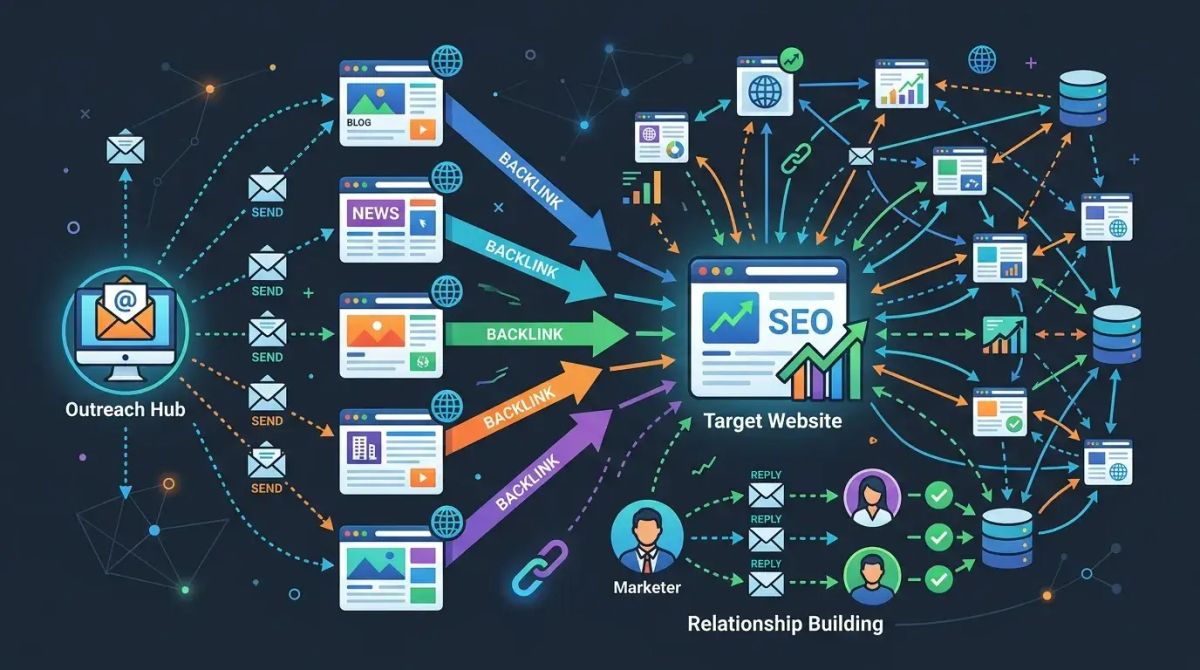
Link building outreach is the process of proactively reaching out to website owners, bloggers, journalists, and content creators to earn backlinks that point to your website. The goal is to provide genuine value to the other party while building an organic and natural link profile.
Outreach-based link building is fundamentally different from purchased or artificially created links. Google's Web Spam team has become increasingly sophisticated at detecting paid and manipulative link schemes. Links earned through genuine outreach are based on editorial decisions and generate natural link signals in Google's eyes.
The Difference Between Outreach and Spam
Outreach involves sending personalized, value-driven messages to carefully selected targets. Spam involves sending copy-paste templates to thousands of recipients through mass email blasts. The difference is substantial. Successful outreach campaigns are personal, research-based, and operate on a principle of mutual benefit.
Why Outreach-Based Link Building Still Works in 2026
At its core, Google's ranking algorithm is built on the concept of PageRank, and this concept remains valid. Backlinks serve as one of the strongest signals of a web page's credibility and authority. Several important factors support this in 2026.
From an E-E-A-T perspective, Google evaluates Experience, Expertise, Authoritativeness, and Trustworthiness partly through backlink profiles. Backlinks from authoritative sources directly increase your site's perceived trustworthiness.
With the proliferation of AI-generated content, anyone can produce content easily. However, backlinks still depend on human editorial decisions. Convincing an editor or blogger to link to your site cannot be automated by artificial intelligence. This makes backlinks an even more important differentiating factor.
From a competitive standpoint, organic competition is increasing in virtually every industry. When content quality is equal across competitors, the backlink profile becomes the primary factor that creates ranking differences.
SEOctopus's Backlink Analyzer module provides detailed analysis of your current backlink profile and enables comparative examination of your competitors' link profiles. This allows you to shape your outreach strategy based on real data.
Finding Link Prospects: Prospecting Strategies
The first step in any successful outreach campaign is identifying the right targets. Instead of emailing random websites, use strategic prospecting methods to discover high-quality link opportunities.
Competitor Backlink Analysis
The most effective prospecting method is examining your competitors' backlink profiles. Sites that link to your competitors are already interested in your industry and open to providing links.
With SEOctopus's Competitor Analysis module, you can view your competitors' strongest backlinks from a single dashboard. Prioritize sites with high Domain Authority that operate in your industry and actively publish content. Sites that link to multiple competitors but not to you represent the highest conversion potential.
Resource Pages
Many websites publish resource pages that list useful links and tools in their industry. These pages are ideal targets for link building because the page owner is already willing to link out.
Use Google search operators like "your industry + resources," "your industry + useful links," or "your industry + inurl:resources" to find resource pages in your niche.
Broken Link Discovery
Broken link building involves finding non-functioning links on websites, informing the page owners, and suggesting your own content as a replacement. This method helps the other party while earning you a backlink.
To find broken links, check your competitors' older backlinks. Pages returning 404 errors represent broken link building opportunities. SEOctopus's backlink analysis tool allows you to quickly identify your competitors' lost backlinks and find these opportunities.
Unlinked Brand Mentions
The unlinked mention strategy identifies instances where your brand or content is mentioned on the web without a link. You can track these opportunities by searching for your brand name on Google or setting up Google Alerts. Politely requesting a link addition to an existing mention typically has a high success rate because the other party already knows and references your content.
Outreach Email Templates
Choosing and personalizing the right template directly impacts outreach success rates. Below are four core outreach email templates that remain effective in 2026.
Guest Post Pitch Template
Subject: Content idea for [Blog Name]
Hi [Name],
I regularly follow your articles on [Blog Name]. I found your piece on [specific article title] particularly insightful.
I have a topic suggestion that I believe would be valuable for your readers: [Topic Title]. In this article, I plan to cover [brief description] in detail.
I can prepare original, research-based content that meets your editorial standards. Happy to share more details if you are interested.
Best regards,
[Your Name]
Broken Link Notification Template
Subject: Found a broken link on your [Page Title] page
Hi [Name],
While reviewing your [Page Title] page, I noticed that the link pointing to [broken link URL] no longer works.
We have a comprehensive guide on the same topic: [Your URL]. You might consider it as a replacement for the broken link.
Either way, I wanted to let you know about the broken link. All the best.
[Your Name]
Resource Page Suggestion Template
Subject: A suggestion for your [Resource Page Title]
Hi [Name],
I found your [Resource Page Title] page extremely useful. I have a resource suggestion that you might consider adding to your list.
We have created a comprehensive guide on [content title and URL] that offers [brief value description]. I believe it would be valuable for your readers.
Here is the link for your review: [URL]
Best regards,
[Your Name]
Skyscraper Technique Template
Subject: An updated resource on [Topic]
Hi [Name],
I noticed you linked to [old content they referenced] in your article. That content was valuable, but some of the information is now outdated.
We have created a more comprehensive and updated guide on the same topic with 2026 data: [URL]. [Specify the specific improvements your content offers].
I thought it could serve as a more current resource for your readers.
Best,
[Your Name]
Personalization Strategies: Avoiding Mass Spam
The most critical element of outreach is personalization. Mass email blasts absolutely do not work in 2026. Email providers' spam filters have become more advanced, and recipients immediately recognize generic messages.
True personalization elements include the following. Using the recipient's name and website is not enough. Reference a specific detail from their content. For example, an opening line like "I was particularly interested in the point you made about Y in your article on X published last week" demonstrates genuine engagement.
Establish social media connections. Before sending an outreach email, engage with your target's content on Twitter, LinkedIn, or other social media platforms. Leave a comment or retweet their shares. These pre-established relationships significantly increase your email open and reply rates.
Segment your outreach. Rather than targeting all prospects with the same template, develop different approaches based on target type. Bloggers, journalists, university pages, and industry directories have different motivations and respond to different value propositions.
Make your value proposition clear. Explicitly state what value you are offering the other party. This could be an original infographic, research data, expert commentary, or simply a broken link notification. Approaching with a mutual benefit principle is always more effective.
Follow-Up Cadence and Best Practices
Not receiving a reply to your first email is completely normal. Research shows that a significant portion of outreach success comes from follow-up emails.
The ideal follow-up cadence works as follows. Send a polite reminder 3 business days after your initial email. If no response comes, send a second follow-up from a different angle 5 business days later. On the third follow-up, offer a different value proposition. If there is no response after three follow-ups, move on to new opportunities.
Key considerations for follow-up emails. Do not repeat your previous email verbatim. Add new information or value with each follow-up. Never use an aggressive or passive-aggressive tone. Maintain a professional and respectful approach throughout.
Timing matters. Research indicates that Tuesday and Wednesday are the most effective days for outreach. Emails sent between 9 and 11 AM achieve the highest open rates. Monday and Friday tend to have lower response rates as people are typically busier.
Tools for Outreach
Using the right tools is essential for running an efficient outreach process.
Hunter.io is one of the most popular tools for finding email addresses on websites. Its domain search feature lists all identifiable email addresses for a given site. The email verification feature also helps minimize bounce rates.
BuzzStream is a comprehensive platform designed for outreach process management. Building target lists, sending emails, automating follow-ups, and tracking performance can all be handled from a single tool. Its team collaboration features make it ideal for large-scale campaigns.
Pitchbox is an outreach tool designed specifically for SEO agencies and large teams. It offers automated prospecting, personalized email sequences, and detailed reporting capabilities.
SEOctopus serves as your foundational tool for backlink analysis and competitor link profile comparison. Analyzing your competitors' backlink profiles when identifying outreach targets allows you to prioritize the most valuable link opportunities.
Guest Posting Strategy
Guest posting remains one of the most effective link building methods in 2026. However, a quality guest posting strategy is vastly different from publishing bulk articles through low-quality blog networks.
Finding Opportunities
Use Google search operators like "your industry + guest post," "your industry + write for us," or "your industry + contribute" to find sites that accept guest posts. However, only target sites with high Domain Authority, real traffic, and relevance to your industry.
Creating Quality Content
Your guest posts should match the quality of content you publish on your own blog. Articles that are research-based, data-driven, and provide genuine value to readers both increase acceptance rates and elevate link value. Generic and superficial content is now consistently rejected by editors.
Bio and Link Placement
Place natural, contextually relevant links within the content in addition to your author bio. Forced or irrelevant link placement alienates both editors and readers. In-content links carry more SEO value than bio links.
Digital PR and Journalist Outreach
Digital PR is the adaptation of traditional public relations to the digital landscape and represents one of the most effective ways to earn powerful backlinks.
HARO and Connectively
The Help A Reporter Out platform, now known as Connectively, is a platform where journalists publish their source requests. By providing expert commentary on queries related to your industry, you can earn backlinks from high-authority news sites.
For a successful HARO strategy, responding quickly is critical. Journalists typically select sources within hours. Your responses should be concise, to the point, and demonstrate expertise. Always include your credentials and qualifications.
Press Releases
You can prepare press releases for developments that carry genuine news value. However, sending press releases for every minor update is perceived as spam. Press releases can be effective for industry firsts, publishing significant research, or major partnerships that truly have newsworthy value.
Data-Driven Content
Journalists and bloggers love unique data and research findings. By conducting surveys in your industry, analyzing your own data, or compiling publicly available data, you can create original statistics. This type of content naturally attracts a large number of backlinks.
Broken Link Building Step by Step
Broken link building is one of the outreach methods with the highest success rate because you offer tangible value to the other party.
Step 1: Identify target sites. List high-authority sites related to your industry. Resource pages, blog posts, and content that heavily uses links are ideal candidates.
Step 2: Find broken links. Use SEOctopus's backlink analysis tool to scan target sites for broken backlinks. Identify links pointing to pages that return 404 errors, enter redirect chains, or no longer exist.
Step 3: Prepare replacement content. Create quality content that can serve as a replacement for the content the broken link originally pointed to, or identify a suitable piece from your existing content.
Step 4: Contact the site owner. Notify them about the broken link in a polite and helpful tone and suggest your content as an alternative.
Step 5: Follow up. If no response comes, apply the follow-up cadence described above.
Skyscraper Technique 2.0
The Skyscraper technique, popularized by Brian Dean, has evolved into a more sophisticated approach in 2026.
Classic Skyscraper involved finding the best content on a topic, creating something better, and reaching out to those who linked to the original content to suggest yours instead.
Skyscraper 2.0 requires more than simply writing longer content. Surpass the original content in the following ways. Add current data and statistics. Offer a different format, such as interactive tools or video content. Improve the user experience. Include expert opinions and case studies. Cover subtopics that the original content missed.
What matters is not more words but more value. Google's Helpful Content system measures content depth and user satisfaction.
Relationship-Based Link Building
The most sustainable link building strategy is building genuine relationships with influential people in your industry.
Community participation involves actively participating in and providing value to forums, Discord servers, Slack groups, and LinkedIn communities in your industry. Over time, as you become a trusted member of these communities, organic link opportunities naturally emerge.
Collaborative content creation such as producing webinars, podcasts, research reports, or ebooks with other experts both improves content quality and helps you reach your partners' audiences. When each partner shares the content on their own platform, natural backlinks are generated.
Event participation by attending industry conferences and events as a speaker or participant both strengthens your personal brand and earns you backlinks from event websites.
Measuring Outreach Success
What gets measured gets managed. Track these metrics to evaluate the success of your outreach campaigns.
Email open rate should target between 40 and 60 percent for a successful outreach campaign. A low open rate indicates problems with your subject line or sending timing.
Response rate of 10 to 20 percent is considered good. Personalized campaigns can reach up to 30 percent response rates.
Link acquisition rate of 5 to 15 percent of emails sent converting to links is considered successful. This rate varies depending on your industry and target quality.
Quality of earned links should also be evaluated beyond just quantity. The Domain Authority, relevance, and traffic potential of earned links matter significantly. SEOctopus's Backlink Analyzer module allows you to monitor the quality and impact of every new link you acquire.
Common Outreach Mistakes to Avoid
Knowing the common mistakes to avoid is essential for a successful outreach strategy.
Lack of personalization is the biggest mistake. Changing just the name and site name is insufficient. Make a specific comment about the recipient's content.
No value proposition means you must clearly state what you are offering the other party. Simply asking for a link does not work.
Targeting the wrong person means contacting the relevant content editor or blog manager rather than the website's general contact address.
Overly aggressive follow-up occurs when more than three follow-ups are perceived as spam. When you receive a no or get no response, move on.
Proposing low-quality content means the content you want to earn links to must genuinely be high quality and valuable. Conducting outreach with weak content damages your brand reputation.
Not measuring results means you cannot know what works if you do not track campaign performance. Monitor the metrics of every campaign regularly.
Frequently Asked Questions
How long does it take for link building outreach to show results?
Outreach campaigns typically show initial results within 2 to 4 weeks. However, the ranking impact of earned backlinks is usually felt within 1 to 3 months. For sustainable results, outreach should be managed as an ongoing process rather than a one-time activity.
How many outreach emails should I send per day?
For quality, personalized outreach, 15 to 30 emails per day is an ideal number. If you are starting with a new email account, begin with 5 emails per day and gradually increase. Mass, non-personalized emails get caught in spam filters and damage your domain reputation.
Is guest posting still effective or does Google penalize it?
Quality guest posts are still effective and are not penalized by Google. What Google opposes is bulk, manipulative guest posting through low-quality blog networks. Guest posts on sites with genuine editorial standards that provide value to readers are completely safe.
What is the success rate of broken link building?
Broken link building typically achieves a 5 to 15 percent link acquisition rate. This rate is higher compared to other outreach methods because you are offering tangible value to the other party. To increase the success rate, the content you suggest as a replacement for the broken link must be genuinely high quality and relevant.
How much personalization is enough in outreach emails?
Each email should contain at least 2 to 3 personalized elements. The recipient's name and site represent the baseline. Beyond that, mentioning a specific piece of their content, establishing a common connection, or making an industry-relevant comment constitutes genuine personalization. Ideally, allocate 3 to 5 minutes of research time per email.
What is the difference between digital PR and traditional link building?
Digital PR targets earning links from high-authority news sites through newsworthy content and journalist relationships. Traditional link building relies on direct communication with bloggers and website owners. Digital PR generally earns higher DA backlinks but requires more creativity and media relationships. Using both approaches together represents the most effective strategy.
What metrics should I track in my outreach campaigns?
Key metrics include email open rate, response rate, link acquisition rate, average Domain Authority of earned links, and cost per campaign. You should also monitor the impact of earned backlinks on organic traffic and ranking changes. SEOctopus's Backlink Analyzer module enables you to automatically track these metrics over time.