SEO Myths Debunked: 17 Common Misconceptions Still Believed in 2026 and the Truth Behind Them
SEO Myths Debunked: 17 Common Misconceptions Still Believed in 2026 and the Truth Behind Them
SEO is one of the most dynamic and continuously evolving fields in digital marketing. However, this rapid pace of change also causes misinformation and myths to spread just as quickly. As we reach 2026, many marketers and business owners still base their SEO strategies on information that either lost its validity years ago or was never accurate in the first place. This results in wasted time, misallocated budgets, and missed opportunities.
In this comprehensive guide, we will examine the 17 most common SEO myths one by one, explain why each is wrong, and present the real situation with evidence. Our goal is to help you build your SEO strategy on solid foundations and direct your resources where they truly matter.
Myth 1: SEO Is Dead
This myth resurfaces every year in a different variation. When AI changes the structure of search, when voice search rises, or when social media platforms grow stronger, someone declares that SEO is dead. Yet the facts tell the opposite story.
The Truth: According to 2026 data, over 53 percent of website traffic still comes from organic search. Google processes more than 8.5 billion searches daily, and this number increases every year. What has changed is not SEO itself but how it is practiced. It has expanded beyond traditional keyword optimization to encompass user experience, content quality, technical infrastructure, and adaptation to AI search engines.
SEOctopus's GEO Monitor feature allows you to track your visibility across both traditional search engines and AI-powered search engines. This helps you see with real data that SEO has not died but has actually become more comprehensive.
Myth 2: Keyword Density Matters
There was a time when the repetition rate of keywords within content was considered a decisive factor for rankings. Guides suggesting that a density between 2 and 5 percent should be targeted still exist.
The Truth: Google's algorithm shifted to semantic analysis with the Hummingbird update in 2013. The subsequent BERT and MUM updates further prioritized understanding the semantic completeness of content and user intent. Today's Google does not count how many times a keyword is repeated but rather evaluates how well the content addresses user intent.
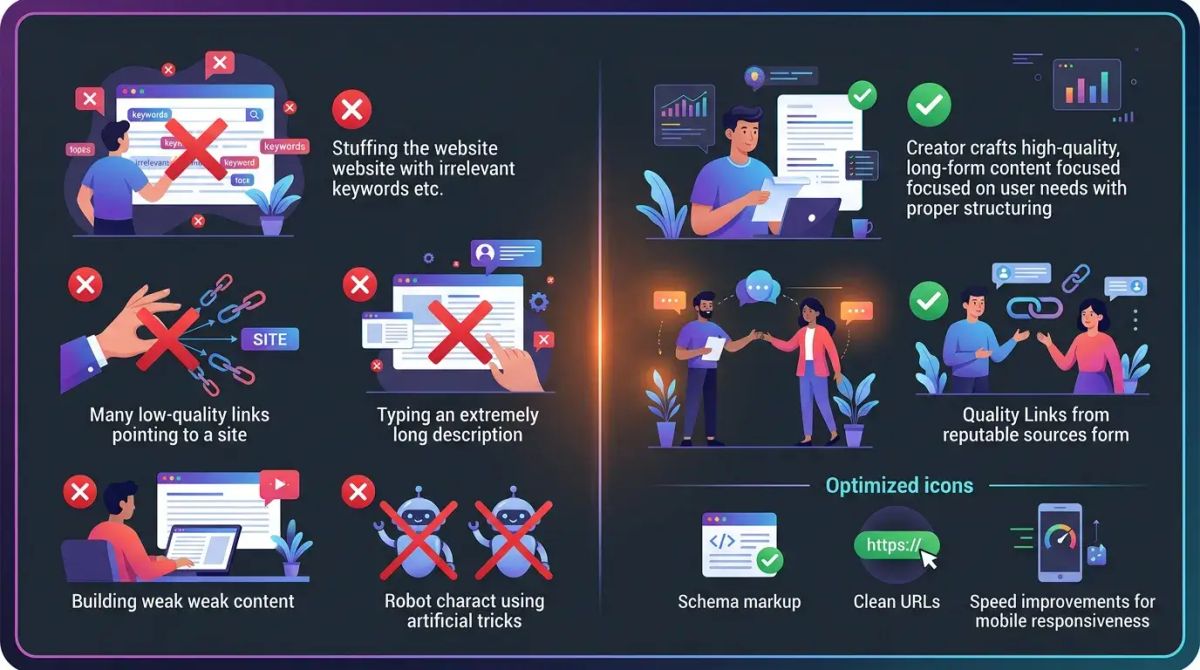
Excessive keyword repetition, known as keyword stuffing, degrades the user experience and can be flagged as a spam signal by Google. Instead, covering the topic comprehensively with natural language, using semantically related terms, and providing clear answers to user questions is far more effective.
Myth 3: Meta Keywords Tag Affects Rankings
The meta keywords HTML tag was once an important signal source for search engines. However, this tag has been completely ineffective for years.
The Truth: Google officially announced in 2009 that it does not use the meta keywords tag as a ranking signal. The reason was that website owners manipulated this tag by adding irrelevant keywords. Bing made the same announcement in 2014. Spending time on this tag is entirely unnecessary.
The meta tags you should focus on are the title tag and the meta description tag. The title tag remains an important ranking signal. The meta description, while not directly affecting rankings, directly impacts click-through rates and can indirectly improve your positioning.
Myth 4: More Pages Equals Better SEO
Some business owners believe that the more pages they create, the better their performance in search engines will be. This assumption presumes a direct relationship between page count and organic traffic.
The Truth: Google prioritizes quality over quantity. Hundreds of pages with thin, low-quality content can weaken your site's overall authority. Google's Helpful Content update evaluates content quality across the entire site. This means that a large number of pages, most of which are low quality, will also drag down the rankings of your quality pages.
The correct strategy is to ensure that each page serves a specific user intent and delivers genuine value. Additionally, conducting regular content audits to update, consolidate, or remove underperforming pages is essential for maintaining a healthy site.
Myth 5: SEO Is a One-Time Task
Some businesses treat SEO as a project. They optimize their website once and expect results to keep flowing indefinitely.
The Truth: SEO is a continuous, ongoing process. Search engines constantly update their algorithms. Google makes hundreds of algorithm updates per year. Your competitors are continuously producing content and performing optimization. User behaviors and search trends change over time. Technical issues can emerge gradually.
SEOctopus's automated monitoring and reporting features enable you to continuously track your site's performance and respond quickly to changes. Weekly or monthly SEO audits are indispensable for a successful organic strategy.
Myth 6: Exact Match Domains Guarantee Rankings
There was a period when domains like best-fishing-gear.com that contained keywords provided a significant advantage. This led to a rush to grab exact match domains.
The Truth: Google largely eliminated the advantage that exact match domains gave to low-quality sites with the EMD update in 2012. Today's Google looks not at the keyword in the domain name but at the site's overall quality, authority, and content relevance.
A domain name that carries a strong brand is far more valuable than a keyword-stuffed domain. As your brand awareness grows, branded searches increase, sending strong authority signals to Google.
Myth 7: Social Media Directly Affects Rankings
It is commonly believed that social media shares, likes, and follower counts are direct Google ranking signals.
The Truth: Google has repeatedly stated that it does not use social media signals as direct ranking factors. However, social media does have indirect effects. Content shared on social media gains more visibility, and this visibility can lead to natural backlink acquisition. Social media profiles can appear in search results, increasing brand visibility. Social traffic can improve user engagement metrics.
Therefore, social media should be part of your SEO strategy, but it should be valued as a channel for content distribution and brand awareness rather than as a factor that directly affects rankings.
Myth 8: Google Ads Improve Organic Rankings
Some business owners believe that when they advertise on Google, they will also be favored in organic results.
The Truth: Google has officially and repeatedly stated that paid advertisements absolutely do not affect organic rankings. Google Ads and organic search are managed by completely separate systems. When you stop your advertising spend, your organic rankings do not change.
However, there can be an indirect effect. Google Ads campaigns can increase brand awareness, which can positively impact branded searches and organic click-through rates. Additionally, you can use keyword performance data obtained from Google Ads to shape your organic SEO strategy.
Myth 9: A Duplicate Content Penalty Exists
Many people believe that Google applies an official penalty for duplicate content.
The Truth: Google does not have a manual penalty mechanism for duplicate content. When encountering duplicate content, Google attempts to determine the original and filters out the others from results. This is a filtering process, not a penalty.
The real issue is that the same content existing at multiple URLs wastes crawl budget and dilutes link equity. You can resolve this by using canonical tags to indicate your preferred URL. SEOctopus's technical SEO audit features automatically detect duplicate content issues on your site and provide canonical tag recommendations.
Myth 10: XML Sitemaps Boost Rankings
It is commonly thought that submitting an XML sitemap will directly increase rankings.
The Truth: An XML sitemap does not directly affect your page rankings. The purpose of sitemaps is to make it easier for search engines to discover and crawl the pages on your site. Sitemaps are particularly important as discoverability tools for large sites, newly added pages, or pages with weak internal linking structures.
Even without a sitemap, Google can find your pages through internal and external links. However, submitting a sitemap is good practice because it provides additional information about your pages to search engines, accelerating the indexing process.
Myth 11: HTTPS Alone Significantly Boosts Rankings
The belief that switching to HTTPS will yield a major ranking boost is widespread.
The Truth: Google announced HTTPS as a ranking signal in 2014. However, this signal is, in Google's own words, a lightweight signal that holds a small share among hundreds of ranking factors. Switching to HTTPS is absolutely the right move from a security and user trust perspective. Chrome marks HTTP sites as not secure. However, expecting a dramatic ranking increase from HTTPS alone is misleading.
You should implement HTTPS not for SEO advantage but for user security, data protection, and compliance with modern web standards. The ranking impact is a bonus.
Myth 12: Link Building Is Spam
Some people believe that all link building efforts are manipulative and contrary to Google's guidelines.
The Truth: What Google opposes are artificial and manipulative link schemes. Buying links, using link farms, or mass comment spamming are indeed grounds for penalties. However, earning natural backlinks by creating quality content, writing guest posts, identifying broken links, or conducting digital PR is a completely legitimate and effective strategy.
Backlinks continue to be one of Google's most important ranking factors. What matters is that backlinks come from natural, high-quality, and relevant sources. SEOctopus's Backlink Analyzer feature analyzes your existing backlink profile, shows the quality distribution, and helps you identify new link opportunities.
Myth 13: AI Will Completely Replace SEO
With the proliferation of ChatGPT, Google SGE, and other AI tools, claims that SEO will become obsolete are increasingly common.
The Truth: AI is not killing SEO but transforming it. AI-powered search engines still reference and cite content from websites. Google's AI Overviews feature provides links to source websites when generating answers. This indicates not that SEO is dead but that it is changing shape.
A successful SEO strategy in 2026 must encompass both traditional search optimization and visibility in AI search engines, known as GEO. SEOctopus is one of the rare platforms that addresses this need. With the GEO Monitor feature, you can track how your brand is referenced across ChatGPT, Perplexity, and other AI engines.
Myth 14: You Need to Submit Your Site to Google
An old belief holds that if you do not manually submit your website to Google, it will never be indexed.
The Truth: Google's crawlers, known as Googlebot, continuously discover new pages by following links across the web. If another indexed site links to your site, Google will find it naturally. Submitting URLs through Google Search Console can speed up the process, but it is not mandatory.
That said, using Google Search Console is still good practice. You can monitor your indexing status, view crawl errors, and access your performance data. However, it is used more for monitoring and optimization purposes than for submitting your site.
Myth 15: SEO Results Are Instant
Some business owners expect SEO work to produce results immediately after starting.
The Truth: SEO is, by its nature, a long-term investment. It generally takes 3 to 6 months to begin seeing the impact of changes made. For some competitive keywords, this timeline can extend to 12 months. Google needs time to crawl, index, evaluate, and position new content in its results.
Patience and consistent effort are the keys to SEO success. SEOctopus's trend tracking graphs visualize the impact of your work over time and allow you to track your progress with concrete data.
Myth 16: H1 Header Tags Must Contain Exact Keywords
The belief that heading tags must contain the exact target keyword verbatim is widespread.
The Truth: Google's John Mueller has stated multiple times that H1 tags are not mandatory and that heading hierarchy is not a direct determinant for rankings. Heading tags are important for the structural organization of content and user experience. Google uses heading tags to understand the topic of the content but does not look for exact match keywords.
The best practice is to write heading tags that are meaningful and descriptive for users. Naturally including the target keyword or close variations is ideal. However, if forcing the keyword disrupts the readability of the content, it is unnecessary.
Myth 17: Images Do Not Affect SEO
Some people think that search engines cannot see visual content at all and that images have no impact on SEO.
The Truth: Image optimization is an important component of SEO. Google Images constitutes a significant portion of total search traffic. Alt text tags help search engines understand the content of images and are also critically important for accessibility.
For image optimization, the following steps should be followed. Write descriptive and relevant alt text. Make file names meaningful, using red-running-shoes.jpg instead of IMG001.jpg. Compress images using web formats such as WebP or AVIF. Apply lazy loading to prevent large images from slowing down page speed. Make images responsive to adapt to different screen sizes. Each of these steps improves both user experience and search engine performance.
The Real Cost of Believing SEO Myths
Believing these myths has tangible consequences. Incorrect prioritization causes you to spend your time on ineffective tactics. False expectations lead to motivation loss. Misdirection prevents you from channeling your resources to the right areas. Worst of all, some myths can lead to practices like over-optimization that increase your risk of Google penalties.
For an SEO strategy based on accurate information, it is essential to follow current sources, read Google's official documentation, and make decisions based on real data. Data-driven tools like SEOctopus ensure that your decisions are made with concrete data rather than intuition.
Conclusion: Trust Data Not Myths
SEO myths most often arise from the misinterpretation of practices that were once valid but are no longer relevant. For a successful SEO strategy in 2026, relying on facts and data is essential. Producing user-focused quality content, building a solid technical infrastructure, earning natural backlinks, and adapting to AI search engines are the factors that truly matter for success.
The SEOctopus platform helps you manage your SEO strategy with data rather than myths. Keyword Discovery identifies the right keywords, GEO Monitor tracks your visibility in AI engines, Backlink Analyzer examines your link profile, and Content Optimizer refines your content based on real performance data.
Frequently Asked Questions
Is SEO really dead?
No, SEO is not dead. According to 2026 data, over 53 percent of web traffic still comes from organic search. What has changed is how SEO is practiced. It now requires not just keyword optimization but also user experience, content quality, technical infrastructure, and adaptation to AI engines.
What should the ideal keyword density be?
Targeting a specific keyword density is unnecessary. Google's modern algorithms work on a semantic basis. Covering the topic comprehensively with natural language and using semantically related terms is sufficient. Keyword stuffing will harm your rankings.
Is the duplicate content penalty real?
Google does not have an official duplicate content penalty. When duplicate content is found, Google prefers the original and filters other versions. This is a filtering process, not a penalty. You can use canonical tags to indicate which version should be preferred.
Does buying Google Ads improve organic rankings?
No, Google has officially stated that paid ads do not affect organic rankings. Google Ads and organic search are completely separate systems. However, advertising campaigns can create indirect positive effects by increasing brand awareness.
How long does it take to see SEO results?
SEO generally begins to show results within 3 to 6 months. In competitive niches, this can extend to 12 months. SEO is a marathon, not a sprint. It requires consistent work and patience. Promises of instant results are usually misleading.
Will AI replace SEO entirely?
No, AI is transforming SEO but not replacing it. AI search engines still reference content from websites. A successful 2026 strategy must cover both traditional SEO and GEO, which is optimization for AI search engines.
Is link building still important?
Yes, backlinks continue to be one of Google's most important ranking factors. What matters is earning links from high-quality, natural, and relevant sources. Spam link schemes are grounds for penalties, but natural links earned through quality content carry significant value.
Does submitting an XML sitemap improve rankings?
An XML sitemap does not directly affect rankings. Its purpose is to help search engines discover pages on your site more easily. Submitting a sitemap is good practice, but it is used for indexing convenience, not for ranking boosts.