Best AI Visibility Tools for SEO in 2026
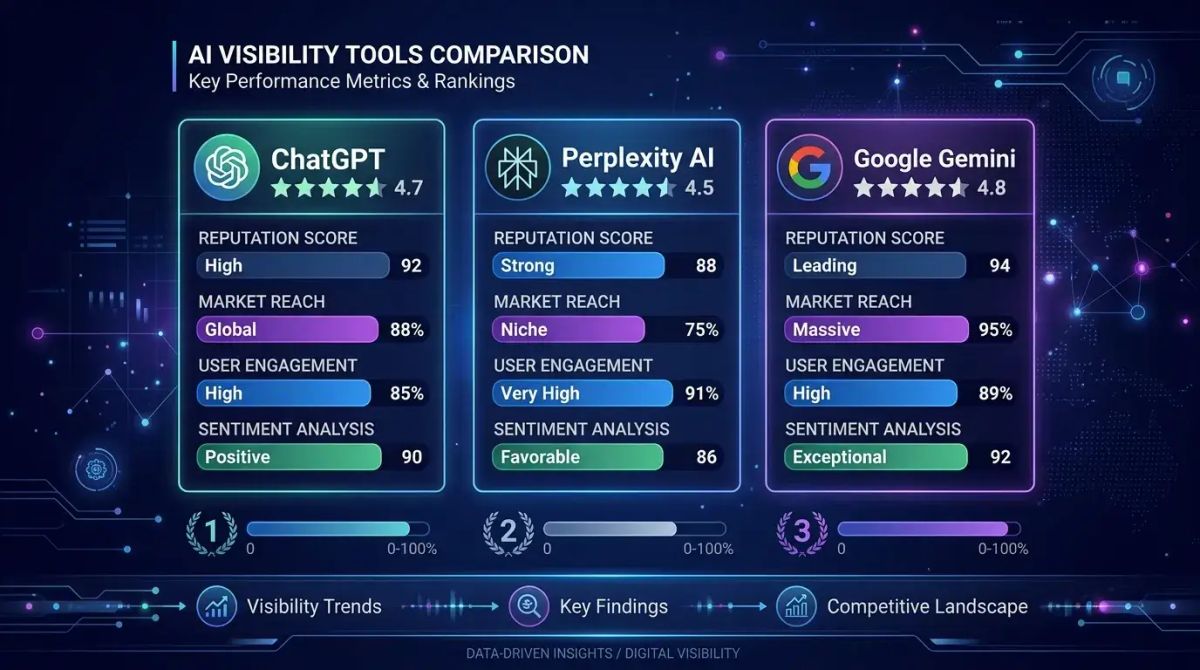
AI Visibility Tools: The Definitive 2026 Comparison Guide
Traditional SEO tools have been indispensable for tracking Google rankings for years. But in 2026, search behavior is undergoing a fundamental shift. A significant portion of users now turn to AI engines like ChatGPT, Gemini, Claude, and Perplexity for information retrieval. When these engines recommend specific brands, products, and sources in their responses, your potential customers are influenced regardless of your traditional search rankings. If you are invisible in AI search, you are leaving money on the table.
AI visibility tools are designed to bridge this gap. In this comprehensive guide, we compare the best AI visibility monitoring tools of 2026, analyze their strengths and weaknesses, and help you choose the right tool for your business.
Why You Need AI Visibility Monitoring in 2026
Search Behavior Is Shifting Rapidly
According to 2026 data, approximately 45 percent of internet users regularly use at least one AI engine during their information search process. This percentage grows every quarter. AI engines are particularly preferred for B2B research, product comparisons, and technical questions where users want direct, synthesized answers rather than browsing through ten blue links.
AI Engines Make Brand Recommendations
When you ask ChatGPT "what is the best project management tool," it responds with a ranked list of specific brands. When Gemini provides information about a product category, it cites specific companies as sources. Perplexity adds websites as citations in its research answers. These recommendations directly influence purchasing decisions, making AI visibility a revenue-impacting metric.
You Cannot Manage What You Cannot Measure
In traditional SEO, you use Google Search Console and Ahrefs to monitor your rankings. But how do you monitor what AI engines say about your brand? Manually querying each AI engine one by one is not scalable. AI visibility tools automate this process, giving you continuous, structured data about your brand presence across AI platforms.
Your Competitors Are Already Monitoring
Forward-thinking competitors in your industry have likely already started AI visibility monitoring. Every day you spend without collecting this data creates a strategic disadvantage that compounds over time.
What Do AI Visibility Tools Actually Do?
AI visibility tools perform several core functions:
- Brand Monitoring: Detect whether your brand is mentioned in AI engine responses for relevant queries
- Visibility Scoring: Quantify your overall brand visibility in AI search with a numerical score
- Citation Tracking: Monitor which of your pages receive citations from AI engines and measure citation quality
- Sentiment Analysis: Determine whether the tone about your brand in AI responses is positive, negative, or neutral
- Competitor Comparison: Compare your AI visibility against competitors for the same keywords
- Trend Analysis: Track how your visibility changes over time to measure the impact of your optimization efforts
Detailed Tool Comparison
1. SEOctopus GEO Monitor
Overview: SEOctopus combines traditional SEO audit and keyword tracking with GEO (Generative Engine Optimization) monitoring in a single platform. It offers the broadest AI engine coverage in the market for visibility tracking.
Key Features:
- 4 AI Engine Monitoring: Tracks ChatGPT, Claude, Gemini, and Perplexity simultaneously. This is one of the broadest coverage options available in any tool today.
- 5-Component Visibility Score: Calculates a weighted score from Presence (is your brand mentioned), Position (where in the response), Prominence (how prominently featured), Sentiment (tone of mention), and Recommendation (direct recommendation status).
- Citation Tracking: Provides detailed tracking of which AI engines cite your site as a source and which specific pages receive citations.
- Sentiment Analysis: Analyzes the response tone about your brand separately for each AI engine, helping you identify engine-specific reputation issues.
- Competitor Comparison: Offers engine-level competitor analysis showing which competitor is more visible in which engine for each keyword.
- Topic Association Map: Visually maps which topics AI engines associate with your brand, revealing opportunities and blind spots.
- Automated Monitoring: Runs checks every 6 hours with change alerts via email.
- SEO Plus GEO Integration: Manage traditional SEO audit, keyword tracking, and GEO monitoring from a single platform with a unified dashboard.
Pros:
- Broadest AI engine support in the market (4 engines)
- SEO and GEO combined in one platform
- Free plan available (3 GEO keywords)
- Affordable pricing tiers
- User-friendly interface with fast onboarding
Cons:
- Relatively newer tool in the market
- Enterprise-level API integrations still in development
Best For: SMBs and digital agencies who want to manage SEO and GEO from a single tool without juggling multiple subscriptions.
2. Otterly.ai
Overview: Otterly.ai is a specialized tool focused on brand monitoring in AI search engines. It primarily tracks brand mentions in ChatGPT and Bing Copilot responses.
Key Features:
- AI search result brand mention tracking
- Weekly visibility reports with trend indicators
- Basic trend analysis and historical data
- ChatGPT and Bing Copilot focused monitoring
- Clean and straightforward dashboard
Pros:
- Easy to use with a minimal learning curve
- Strong ChatGPT monitoring capabilities
- Automated weekly reports suitable for executive sharing
Cons:
- Limited AI engine support (typically 2 engines)
- No detailed multi-component visibility score
- No integration with traditional SEO tools
- Pricing can be high for small businesses
- Limited or no support for Claude and Gemini monitoring
Best For: Larger brands focused primarily on ChatGPT visibility who need simple, executive-friendly reports.
3. Profound
Overview: Profound (previously referenced in some contexts as related to Scrunch AI) is a technically-oriented platform focused on monitoring brand presence in LLM outputs. It takes an API-first approach aimed at developer teams.
Key Features:
- LLM response brand and product monitoring
- Sentiment analysis and tone tracking
- API access for custom integrations and automation
- Bulk query support for large-scale monitoring
- Raw data export capabilities
Pros:
- Powerful API infrastructure for custom workflows
- Flexible data export options
- Ideal for technical teams who want to build custom dashboards
- Detailed sentiment analysis
Cons:
- Requires technical knowledge for setup and configuration
- Lacks a user-friendly visual dashboard for non-technical users
- Does not offer SEO tools on its own
- Enterprise-focused pricing that is prohibitive for small businesses
- Complex onboarding process
Best For: Large technology companies and enterprise organizations with dedicated developer teams who need programmatic access to AI visibility data.
4. Peec AI
Overview: Peec AI is a platform focused on monitoring and optimizing AI search visibility. It distinguishes itself by providing content optimization recommendations alongside monitoring.
Key Features:
- AI search visibility monitoring
- Content optimization recommendations with actionable suggestions
- Competitor benchmarking features
- Visibility trend graphs with historical data
- Content gap analysis identifying topics where you lack AI presence
Pros:
- Provides actionable content optimization suggestions
- User-friendly interface with visual reporting
- Solid competitor comparison features
Cons:
- Limited AI engine coverage
- Citation tracking lacks depth
- No integration with traditional SEO tools
- Relatively less known in the market
- Pricing transparency could be improved
Best For: Mid-size businesses focused on developing a content-driven AI visibility strategy.
5. Scrunch AI
Overview: Scrunch AI is a monitoring tool focused on measuring brand perception in AI engine responses. It approaches AI visibility from a brand reputation management perspective.
Key Features:
- Brand perception monitoring in AI responses
- Negative mention alerts and notifications
- Competitor mention comparison
- Historical data archive for trend analysis
- Basic reporting and export features
Pros:
- Brand reputation-focused approach
- Useful negative mention alerts for crisis prevention
- Clean and simple interface
Cons:
- No comprehensive visibility score
- Limited engine support
- No SEO tool integration
- Lacks detailed citation analysis
- Feature restrictions on non-enterprise plans
Best For: Larger brands and PR agencies where brand reputation management in AI responses is the primary concern.
Manual Monitoring Methods
Before investing in a paid tool, you can manually check your AI visibility. This method does not scale but provides a useful starting point.
Direct Querying:
- Ask ChatGPT, Gemini, Claude, and Perplexity questions relevant to your industry one by one
- Note whether your brand is mentioned in each response
- Record how frequently competitors are mentioned instead
Structured Testing:
- Prepare a list of 10 to 20 key queries that your target audience would ask
- Submit each query to each AI engine
- Record results in a spreadsheet with columns for engine, query, brand mentioned, position, and sentiment
- Repeat this process weekly or biweekly
Limitations:
- AI engines can give different answers to the same question at different times
- Not scalable beyond a dozen keywords
- No automated trend analysis possible
- No alert system for sudden changes
- Time-consuming and prone to human recording error
Tool Comparison Table
| Feature | SEOctopus | Otterly.ai | Profound | Peec AI | Scrunch AI |
|---|---|---|---|---|---|
| AI Engines | 4 | 2 | 2-3 | 2 | 2 |
| Visibility Score | 5-component | Basic | Available | Available | None |
| Citation Tracking | Detailed | Limited | Via API | Limited | None |
| Sentiment Analysis | Yes | No | Yes | No | Yes |
| Competitor Comparison | Detailed | Basic | Via API | Yes | Basic |
| SEO Integration | Built-in | None | None | None | None |
| Free Plan | Yes | No | No | No | Limited |
| Price Range | Affordable | High | Enterprise | Medium | Medium-High |
| Auto Monitoring | Every 6h | Weekly | Configurable | Daily | Weekly |
| API Access | In development | None | Strong | Limited | None |
How to Choose the Right Tool
By Budget
- Free start: Begin with SEOctopus free plan to monitor 3 GEO keywords across 4 AI engines
- SMB budget: SEOctopus Starter or Pro plans offer the best price-to-performance ratio
- Enterprise budget: Profound or Otterly.ai can be evaluated for detailed API integrations
By Need
- Both SEO and GEO: SEOctopus stands out with its unified single-platform approach
- AI monitoring only: Otterly.ai or Peec AI may suffice for focused use cases
- Technical integration: Profound's API-first architecture is the best option for custom workflows
- Brand reputation: Scrunch AI's reputation-focused approach is worth considering
By Team Structure
- Small team or solo: SEOctopus offers the fastest onboarding with its user-friendly interface
- Technical team: Profound's API integrations allow building custom automation pipelines
- Marketing team: Otterly.ai or Peec AI provide straightforward reports suitable for stakeholder presentations
Setting Up an AI Visibility Monitoring Workflow
Step 1: Define Your Target Keywords
Determine which keywords you want to monitor for AI visibility. Start with your brand name, primary product and service categories, frequently asked questions in your industry, and competitor comparison queries.
Step 2: Select and Configure Your Tool
Choose the tool that fits your budget and needs. To start with SEOctopus, sign up for the free plan, add your GEO keywords, and launch your first scan. The initial data collection usually takes a few hours.
Step 3: Establish Your Baseline
After collecting initial data, document your current AI visibility status across all monitored engines and keywords. This becomes your reference point for measuring all future improvements.
Step 4: Regular Monitoring and Action
Review weekly reports, analyze drops and increases, and take action. Improve content in areas where you see visibility drops. Double down on strategies that drive visibility increases. Set up alerts for significant changes that require immediate attention.
Key Metrics to Track
Visibility Score
A composite score measuring how frequently and prominently your brand appears in AI responses. SEOctopus's 5-component score provides the most comprehensive measurement by combining presence, position, prominence, sentiment, and recommendation signals.
Citation Rate
The rate at which AI engines cite your website as a source in their responses. A high citation rate indicates that AI engines consider your site a trustworthy and authoritative source worth referencing.
Sentiment Score
A metric indicating whether the tone about your brand in AI responses is positive, negative, or neutral. Taking quick action on negative sentiment is critical because AI responses influence thousands of users daily.
Competitor Gap
The difference between your competitors' AI visibility and yours for the same keywords. This metric is the most valuable data point for strategic prioritization, showing exactly where you need to invest effort.
Engine Distribution
The distribution of your visibility across different AI engines. You might be strong in ChatGPT but weak in Gemini, and understanding the cause of this difference shapes your optimization strategy.
Integrating AI Visibility with Traditional SEO Reporting
Combining AI visibility data with your traditional SEO reports creates a holistic picture of your digital marketing performance.
Unified Dashboard: Tools like SEOctopus that offer both SEO and GEO data in a single dashboard make this integration natural and seamless.
Correlation Analysis: Examine the correlation between your Google rankings and AI visibility. Strong organic performance generally has a positive effect on AI visibility, but the relationship is not always direct. Some pages rank well on Google but are invisible in AI responses, and vice versa.
Content Strategy: Identify content that performs well in traditional SEO but is missing from AI responses. Enrich this content with E-E-A-T signals, structured data, and detailed expert opinions to boost AI visibility.
Reporting Cadence: Add an AI visibility section to your monthly SEO reports. This gives executives and stakeholders the complete picture of your digital presence across both traditional search and AI platforms.
Frequently Asked Questions
Is there a free AI visibility tool?
Yes. SEOctopus's free plan lets you monitor 3 GEO keywords across 4 AI engines. You can also manually query AI engines to check your visibility, but this approach does not scale and lacks historical tracking capabilities.
How often should AI visibility be checked?
With automated tools, as frequently as possible is ideal. SEOctopus checks automatically every 6 hours. If you are checking manually, once a week is a reasonable starting point. For critical brand queries, daily monitoring is recommended.
How is an AI visibility score calculated?
It varies by tool. SEOctopus uses a 5-component score: Presence (is your brand mentioned), Position (location in the response, with earlier mentions scoring higher), Prominence (level of detail in the mention), Sentiment (positive or negative tone), and Recommendation (direct recommendation status). These components are combined using a weighted average.
How can I improve my AI visibility?
Strengthen your E-E-A-T signals (Experience, Expertise, Authoritativeness, Trustworthiness). Use structured data markup. Produce detailed, citation-worthy content. Create content that directly answers frequently asked questions. Build brand authority through digital PR and industry thought leadership.
Why do different AI engines show different results?
Each AI engine uses different training data, different levels of freshness, and different algorithms. ChatGPT and Claude access different knowledge sources, while Perplexity performs real-time web searches. This is why they produce different answers to the same question, and monitoring multiple engines simultaneously is critically important.
Does AI visibility monitoring replace SEO?
No. AI visibility monitoring is a complement to traditional SEO, not a replacement. Google still drives the majority of web traffic. However, AI searches are growing rapidly, and ignoring this channel would be a strategic mistake. The ideal approach is managing both SEO and GEO together, which is exactly what tools like SEOctopus are designed for.
Should small businesses care about AI visibility?
Absolutely. When your potential customers ask ChatGPT "what is the best X service provider in my city," your brand needs to be in that answer. Early movers in AI visibility gain a significant advantage over larger, slower competitors. You can start today for free with SEOctopus's free plan.
Conclusion
In 2026, AI visibility monitoring is no longer a luxury. It is a mandatory component of any serious digital marketing strategy. AI engines recommend brands to millions of users every day, and you need to know whether you are visible in those recommendations.
Among the tools on the market, SEOctopus stands out for SMBs and digital agencies with its simultaneous monitoring of 4 AI engines, unified SEO and GEO integration, and affordable pricing. Start with the free plan today to discover your AI visibility baseline and build your optimization strategy from there.